Schneckengetriebe für Maschinen in der Lebensmittel- und Pharmaindustrie
Verwendung eines Standard-Industriegeräts Schneckengetriebe In der Lebensmittel- oder Pharmaproduktion geht es nicht um Leistung, sondern um Konformität. NSF-H1-Schmierung, Edelstahlgehäuse, IP67-Schutzart und hygienische Installationskonstruktion sind in diesem Sektor keine optionalen Extras.
Drei Anforderungen, die Standard-Schneckengetriebe nicht erfüllen
Wenn ein Schneckengetriebe Wird eine Anlage in einem Produktionsbereich für Lebensmittel, Getränke oder pharmazeutische Produkte installiert, gelten neben den für die industrielle Standardauswahl geltenden mechanischen Leistungsspezifikationen drei weitere Anforderungen. Das Verständnis dieser drei Ebenen ist entscheidend, um eine vorschriftsmäßige Installation von einem Haftungsrisiko zu unterscheiden.
Schicht 1 – Materialkonformität: Alle Substanzen, die direkt oder indirekt mit Lebensmitteln in Berührung kommen könnten – einschließlich Schmierstoffe, die auslaufen oder spritzen könnten – müssen den geltenden Vorschriften für Lebensmittelkontakt entsprechen. In Korea gilt das Lebensmittelhygienegesetz. Für Export- und Audit-Konformität ist die NSF-Zertifizierung (National Sanitation Foundation) der internationale Standard. Die Verwendung von herkömmlichem Mineralöl in einem Schneckengetriebe oberhalb einer Lebensmittelverarbeitungslinie birgt das Risiko, bei Audits durchzufallen, unabhängig davon, ob das Öl jemals mit dem Produkt in Berührung kommt.
Schicht 2 – Reinigungsfähigkeit: Anlagen in der Lebensmittelproduktion werden planmäßig gereinigt – täglich, pro Schicht oder je nach Produktart auch häufiger. Die Reinigung erfolgt entweder manuell oder mittels CIP (Clean-in-Place), wobei die Reinigungslösung durch die Produktionslinie zirkuliert. Die Oberfläche des Schneckengetriebegehäuses muss Flüssigkeit abweisen und darf sie nicht einschließen. Bereiche, in denen sich Produktreste oder Reinigungslösung ansammeln – wie Vertiefungen, horizontale Kanten oder Schraubenkopftaschen –, stellen zwischen den Reinigungszyklen Kontaminationsquellen dar.
Schicht 3 – Leckageverhinderung: Bei einem Standard-Schneckengetriebe mit verschlissenen Wellendichtungen tritt mit der Zeit Öl an den Wellenaustrittsstellen aus. In einem allgemeinen Industriebetrieb handelt es sich dabei um ein Wartungsproblem. In der Lebensmittelproduktion, beispielsweise über einem Förderband oder einer Abfüllanlage, führt Ölaustritt jedoch zu einer Produktverunreinigung, die einen Produktionsstopp, eine Rückrufaktion und gegebenenfalls behördliche Maßnahmen nach sich zieht.
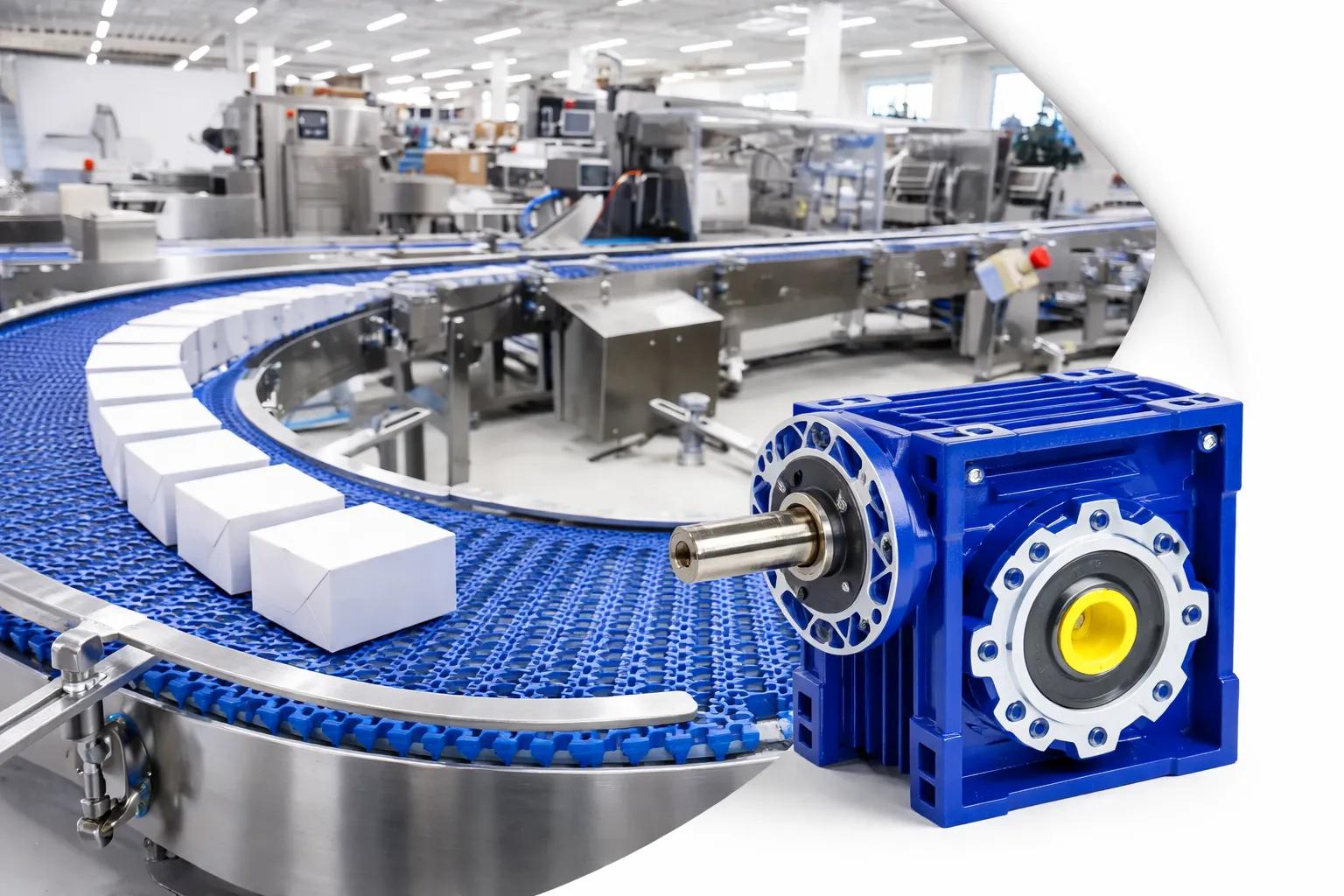
Anwendungsmatrix für Lebensmittel und Pharmazeutika
Die folgende Tabelle zeigt, wo ein Schneckengetriebe wird in Maschinen der Lebensmittel-, Getränke- und Pharmaindustrie eingesetzt, wobei an jeder Position die entsprechenden Anforderungen zu erfüllen sind.
| Gerätetyp | Reduzierstückposition | Mindest-IP | Wichtigste Compliance-Anforderung |
|---|---|---|---|
| Förderband für Lebensmittel | Riemenantriebskopf | IP65 | NSF H1-Schmierstoff; Edelstahlgehäuse bevorzugt |
| Flüssigkeitsabfüllmaschine | Kolben- oder Ventilantrieb | IP67 | NSF H1; VITON-Dichtungen; CIP-Waschkompatibel |
| Mischen und Pürieren | Rührwerkswellenantrieb | IP65 | NSF H1; abgedichtete Doppellippen-Wellendichtung |
| Verpackungsmaschine | Filmzuführung / Formung | IP54 | NSF H1 bevorzugt; kein Kontaminationsrisiko |
| Tablettenpressenzuführung | Pulverdosierantrieb | IP65 | Materialien in Pharmaqualität; reinraumtauglich |
| Getränkeabfüllanlage | Drehmoment der Kappe / Förderband | IP67 | NSF H1; kompatibel mit Hochdruckspülzyklen |
| Verarbeitung von Tiefkühlkost | Förderband- oder Schneidantrieb | IP67 | NSF H1 Tieftemperaturöl; Schmierleistung bei Kaltstart |
| Reinraumautomatisierung | Positionierung oder Transfer | IP65 | Geschlossene Bauweise; keine freiliegenden Befestigungstaschen; geringe Partikelemission |
Materialien und Zertifizierungsanforderungen: Was die einzelnen Normen tatsächlich bedeuten
NSF H1 Schmierstoff – Nicht dasselbe wie „Lebensmittelqualität“
NSF H1 ist die spezielle Zertifizierung für Schmierstoffe, die für den gelegentlichen Kontakt mit Lebensmitteln geeignet sind – sie können versehentlich mit Lebensmitteln in Berührung kommen (Spritzer, Tropfen), ohne dass diese dadurch gesundheitsgefährdend werden. NSF H1-Öle basieren auf Weißmineralöl oder PAO-Grundölen und enthalten Additive, die alle auf der FDA-Zulassungsliste gemäß 21 CFR 178.3620 aufgeführt sind.
Die Angabe „Lebensmittelqualität“ ohne NSF-H1-Zertifizierung ist kein aussagekräftiger Nachweis der Konformität. Ein Lieferant, der ein Schmiermittel ohne NSF-H1-Nummer als „lebensmittelgeeignet“ bezeichnet, liefert lediglich Marketingfloskeln, keinen Nachweis der Konformität. Fragen Sie daher immer nach der NSF-H1-Registrierungsnummer.
Gehäusematerial: Wenn Edelstahl erforderlich
Standardmäßige Aluminiumgehäuse für NMRV-Systeme mit eloxierter Oberfläche sind in vielen Lebensmittelproduktionsumgebungen zulässig. Gehäuse aus Edelstahl SUS304 sind erforderlich, wenn sich das Gerät direkt in einer Nasszone (über den Produktionslinien) befindet, wenn chlorierte Reinigungsmittel verwendet werden, die Aluminium angreifen können, oder wenn die Lebensmittelsicherheitsstandards oder der HACCP-Plan des Kunden Edelstahl für alle Anlagenteile vorschreiben.
Lackiertes Gusseisen ist in Lebensmittelbereichen nicht zulässig, da Lacksplitter eine Kontaminationsquelle darstellen. Aluminium oder Edelstahl sind die beiden geeigneten Materialien.
Dichtungsmaterial: VITON oder PTFE, nicht NBR
Standardmäßige Wellendichtungen für Schneckengetriebe verwenden Lippenmaterial aus NBR (Nitrilkautschuk). NBR ist beständig gegen Mineralöle, zersetzt sich jedoch bei Kontakt mit chlorierten Reinigungsmitteln, Ozon und bestimmten Säuren in Lebensmitteln – Stoffe, die alle in der Lebensmittelproduktion vorkommen.
Für Schneckengetriebe in der Lebensmittel- und Pharmaindustrie sollten Wellendichtungen aus VITON (FKM) verwendet werden. VITON ist beständig gegen chlorierte Reinigungsmittel, verdünnte Säuren, CIP-Chemikalien und Ozon, ohne zu quellen oder auszuhärten. Es bietet zudem einen größeren Einsatztemperaturbereich als NBR.
IP67: Der Standard für Spritzwasserschutz
IP67 bedeutet, dass das Gerät gegen vollständiges Eintauchen in Wasser bis zu einer Tiefe von 1 Meter für 30 Minuten geschützt ist. In der Lebensmittelproduktion bedeutet IP67, dass das Schneckengetriebe einer Hochdruckreinigung mit heißem Wasser und Reinigungsmittel standhält, ohne dass Wasser eindringt – das gängigste Reinigungsverfahren in Lebensmittelbetrieben.
IP65 (Schutz gegen Wasserstrahl) ist ausreichend für Bereiche, in denen das Schneckengetriebe mit einem Schlauch abgespült wird, aber nicht direkt einem anhaltenden Hochdruckstrahl ausgesetzt ist.
XRV050 Schneckengetriebe aus Edelstahl: Spezifikation für die Lebensmittel- und Pharmaindustrie
Die XRV050-Serie ist das Schneckengetriebe aus Edelstahl in Lebensmittelqualität aus dem Produktsortiment von Korea Ever-Power, das speziell für Anwendungen in der Lebensmittel-, Getränke-, Fisch- und Pharmaindustrie mit feuchten Bereichen entwickelt wurde.

| Parameter | XRV050 (Lebensmittelqualität) | Standard NMRV050 |
|---|---|---|
| Gehäusematerial | Edelstahl SUS304 | Aluminiumlegierung ADC12 |
| Wellendichtungsmaterial | VITON (FKM) | NBR (Standard) |
| Schutzart IP | IP67 | IP54 (Standard) |
| Befestigungselemente | Edelstahl SUS304 | verzinkter Stahl |
| Schmierstoff (Werksbefüllung) | NSF H1-registriertes, lebensmittelsicheres Öl | ISO VG 220 Mineralöl |
| Oberflächenbeschaffenheit | Glatte Oberfläche mit minimalen Spalten (Ra ≤ 3,2 μm) | Druckgussoberfläche |
| Typische Anwendung | Lebensmittel, Getränke, Pharmazeutika, Meeresfrüchte, Schlachthof | Allgemeine Industrie |
Reinigungseinschränkung: Verwenden Sie keine Reiniger mit einer Chloridkonzentration über 200 ppm auf Edelstahl SUS304 – dies führt zu Lochfraßkorrosion. Für CIP-Reinigungsverfahren mit hohem Chlorgehalt ist Edelstahl SUS316 erforderlich. Prüfen Sie die Spezifikation Ihres Reinigungsmittels, bevor Sie die Materialauswahl abschließen.
Installationsplanung für Hygienezonen: Vier Prinzipien
Prinzip 1: Totzonen beseitigen
Montieren Sie das Schneckengetriebe in einem selbstentleerenden Winkel – vermeiden Sie horizontale Flächen, auf denen sich Flüssigkeit ansammeln kann. Alle Montageflächen müssen so ausgerichtet sein, dass Flüssigkeit in Richtung eines Abflusses abfließen kann. Schraubenkopfvertiefungen und horizontale Kanten an der Gehäuseaußenseite sollten nach Möglichkeit mit lebensmittelechtem Silikon abgedichtet oder das Gehäuse so ausgerichtet werden, dass sie nach unten zeigen.
Prinzip 2: Abtriebswelle für Inspektionszwecke zugänglich halten
Die Abtriebswellenabdichtung stellt die größte Leckagegefahr dar. Die Anlage muss so konstruiert sein, dass dieser Bereich während des Betriebs visuell inspiziert und im Rahmen der planmäßigen Wartung für den Dichtungsaustausch zugänglich ist. Die Abtriebswellenzone innerhalb eines Maschinengehäuses einzuschließen, wo sie weder einsehbar noch zugänglich ist, ist aus hygienischen Gründen ungeeignet – jegliches Ölleck bleibt unbemerkt, bis es zu einer Kontamination kommt.
Prinzip 3: Dichtungen und Dichtringe zeigen nach unten
Alle Dichtungen und statischen Dichtflächen am Gehäuse des Schneckengetriebes – Gehäusefuge, Öleinfüllschraube, Inspektionsöffnung – müssen nach unten oder zur Seite zeigen, niemals nach oben. Eine nach oben gerichtete Dichtung wirkt wie eine Flüssigkeitsfalle, in der sich verunreinigtes Wasser ständig sammelt, was den Verschleiß des Dichtungsmaterials beschleunigt und zu einer Ansammlung von Verunreinigungen führt.
Prinzip 4: Mindestbodenfreiheit einhalten
Montieren Sie das Schneckengetriebe mit ausreichendem Abstand zum Boden oder Maschinensockel, damit Reinigungsgeräte darunter gelangen können – in der Regel sind gemäß Lebensmittelsicherheitsstandards mindestens 200 mm Abstand erforderlich. Ein direkt auf dem Boden montiertes Getriebe kann nicht ordnungsgemäß darunter gereinigt werden, wodurch sich eine Zone mit Kontaminationsansammlungen bildet.
Drei Anwendungsfälle aus dem Lebensmittel- und Pharmabereich
Fallbeispiel 1: Koreanisches Lebensmittelverpackungswerk – CIP-Produktionslinie
Anwendung: Der Förderbandantrieb einer Verpackungslinie für Fertiggerichte wird zweimal täglich mit einem Heißwasser-CIP-Zyklus gereinigt. Das Förderband verläuft oberhalb der Verpackungssiegelzone – jegliches Tropfen vom Antrieb stellt ein direktes Risiko der Produktkontamination dar.
Ausgewähltes Schneckengetriebe: Edelstahl XRV050 (40:1), NSF H1-Öl, Schutzart IP67, VITON-Dichtungen. Gehäuse mit horizontaler Abtriebswelle und von oben zugänglicher Öleinfüllöffnung für Wartungsarbeiten.
Ergebnis der Prüfung: Die Anlage hat ein externes Lebensmittelsicherheitsaudit ohne Beanstandungen im Bereich des Antriebssystems bestanden. Der Auditor hob insbesondere das Edelstahlgehäuse, das vorliegende NSF-H1-Ölzertifikat und die gut zugängliche Ablassöffnung als konform hervor.
Fallbeispiel 2: Getränkeabfüllmaschine – Dosiermechanismus
Anwendung: Volumetrischer Dosiermechanismus an einer Abfüllanlage für Getränke in Flaschen. Drehmoment 85 Nm bei 22 U/min, Betrieb 16 Stunden/Tag, 5 Tage/Woche. Die Maschine wird zwischen den Abfüllungen mit Hochdruckwasser gespült.
Ausgewähltes Schneckengetriebe: NMRV-050 mit verbesserten VITON-Dichtungen und NSF H1-Schmierstoff im Verhältnis 60:1, IP65. Vollständige Ausführung in Edelstahl XRV050 ist hier nicht erforderlich – der Reduzierer befindet sich in einer Sekundärzone oberhalb der Produktzone, wobei zwischen Reduzierer und Füllkopf ein Tropfschutz installiert ist.
Wichtigste Erkenntnisse: Durch den Tropfschutz wird die Lebensmittelkontaktzone von der Antriebszone getrennt, wodurch ein Schneckengetriebe mit Aluminiumgehäuse und NSF H1-Öl die HACCP-Plan-Anforderungen des Kunden zu geringeren Kosten als eine Komplettlösung aus Edelstahl erfüllen kann.
Fallbeispiel 3: Pharmazeutische Tablettenpresse – Pulverzuführung
Anwendung: Pulverzuführungsantrieb an einer Tablettenpresse in einer GMP-konformen pharmazeutischen Produktionsstätte. Reinraumklasse ISO 7. Der Antrieb arbeitet mit einem Drehmoment von 45 Nm und 18 U/min. Der Bereich wird zwischen den Chargen mit Alkoholtüchern und einem Staubsauger gereinigt.
Ausgewähltes Schneckengetriebe: NMRV-040 mit eloxiertem Aluminiumgehäuse, NSF H1-Schmierstoff, VITON-Dichtungen, IP65. Die glatte, eloxierte Gehäuseoberfläche gibt beim Abwischen keine Partikel ab.
Notiz: In Reinräumen der Pharmaindustrie wird für Reduzierstücke, die nicht in direktem Produktkontakt stehen, häufig eloxiertes Aluminium gegenüber Edelstahl bevorzugt – die eloxierte Oberfläche ist härter und partikelbeständiger als blankes SUS304 und leichter, was die Einhaltung der Vorschriften für den Gerätetransfer erleichtert.


Schneckengetriebe im Vergleich zu Alternativen in Lebensmittel- und Pharmaanwendungen
Der Schneckengetriebe Der NMRV/XRV-Antrieb ist der am häufigsten verwendete Antrieb in Förderanlagen, Misch- und Dosieranlagen der Lebensmittel- und Pharmaindustrie. Die Gründe hierfür sind eher praktischer als theoretischer Natur: Der rechtwinklige Abtrieb ist Standard für diese Maschinen, die Selbsthemmung verhindert ein Rücklaufrisiko bei stromlosem Motor, und die kompakte Bauform ermöglicht die Integration mit Standard-IEC-Motorflanschen ohne zusätzliche Kupplungselemente.
Stirnradgetriebe bieten einen höheren Wirkungsgrad – relevant für große Lebensmittelverarbeitungsanlagen mit hohem Energieaufwand –, benötigen jedoch separate 90°-Kegelradstufen für rechtwinklige Abtriebe und sind hygienisch aufwendiger abzudichten. Planetengetriebe werden in der pharmazeutischen Industrie für hochpräzise Positionieranwendungen eingesetzt, bei denen die Kontrolle des Zahnflankenspiels entscheidend ist, sind aber deutlich teurer und erfordern komplexere hygienische Abdichtungsanforderungen.
Für die Mehrzahl der Antriebsanwendungen in der Lebensmittel- und Pharmaindustrie bei Drehzahlen unter 60 U/min und Drehmomenten unter 500 N·m ist das lebensmittelgeeignete Schneckengetriebe – korrekt spezifiziert mit NSF H1-Öl, VITON-Dichtungen und entsprechender IP-Schutzart – die optimale Kombination aus Konformität, Kompaktheit und Kosten.
Häufig gestellte Fragen – Schneckengetriebe für die Lebensmittel- und Pharmaindustrie
Worin besteht der praktische Unterschied zwischen NSF H1 und einem Schmierstoff, der einfach als „lebensmittelgeeignet“ bezeichnet wird?
Worin besteht der Unterschied zwischen IP65 und IP67 hinsichtlich der Beständigkeit gegen Reinigungsdruck?
Verhindert ein Edelstahlgehäuse jegliche Korrosion in Lebensmittelumgebungen?
Wie wirkt sich eine Tiefkühlumgebung bei -30°C auf die Schmierung eines Schneckengetriebes aus?
Kann die Abtriebswelle des Schneckengetriebes direkt mit Lebensmitteln in Berührung kommen?
Muss ein lebensmittelgeeignetes Schneckengetriebe regelmäßig desinfiziert werden?
Lebensmittelgeeignete Schneckengetriebe: NSF H1, IP67, Edelstahl
Als Spezialist Lieferant von SchneckengetriebenKorea Ever-Power bietet Kunden aus der Lebensmittel- und Pharmaindustrie Edelstahlaggregate der Serie XRV050, lebensmittelkonforme NMRV-Upgrades mit NSF-H1-Zertifizierung sowie anwendungstechnische Unterstützung. NSF-H1-Ölregistrierungsnummern, Materialzertifikate und VITON-Dichtungsspezifikationen werden mit jeder Bestellung aus dem Lebensmittelbereich bereitgestellt.
Herausgeber: Cxm