Worm Gear Reducers for Hoists and Lifts: Safety & Sizing
In a hoist or lift drive, the Schneckengetriebe self-locking behavior is not a convenience feature — it is a safety characteristic that either works correctly or creates a hazard. This guide explains the physics behind self-locking, the conditions that can undermine it, and how to size the reducer correctly for safe continuous service.
Why Hoist and Lift Drives Have Fundamentally Different Requirements
Most power transmission applications prioritize efficiency. A conveyor drive running 20 hours per day benefits materially from a 5% improvement in reducer efficiency. A hoist drive does not operate on that logic. In a hoist, the primary requirement is that the suspended load stays exactly where it is placed when the motor stops — no drift, no creep, no controlled descent under gravity. Everything else, including efficiency, is secondary to this safety function.
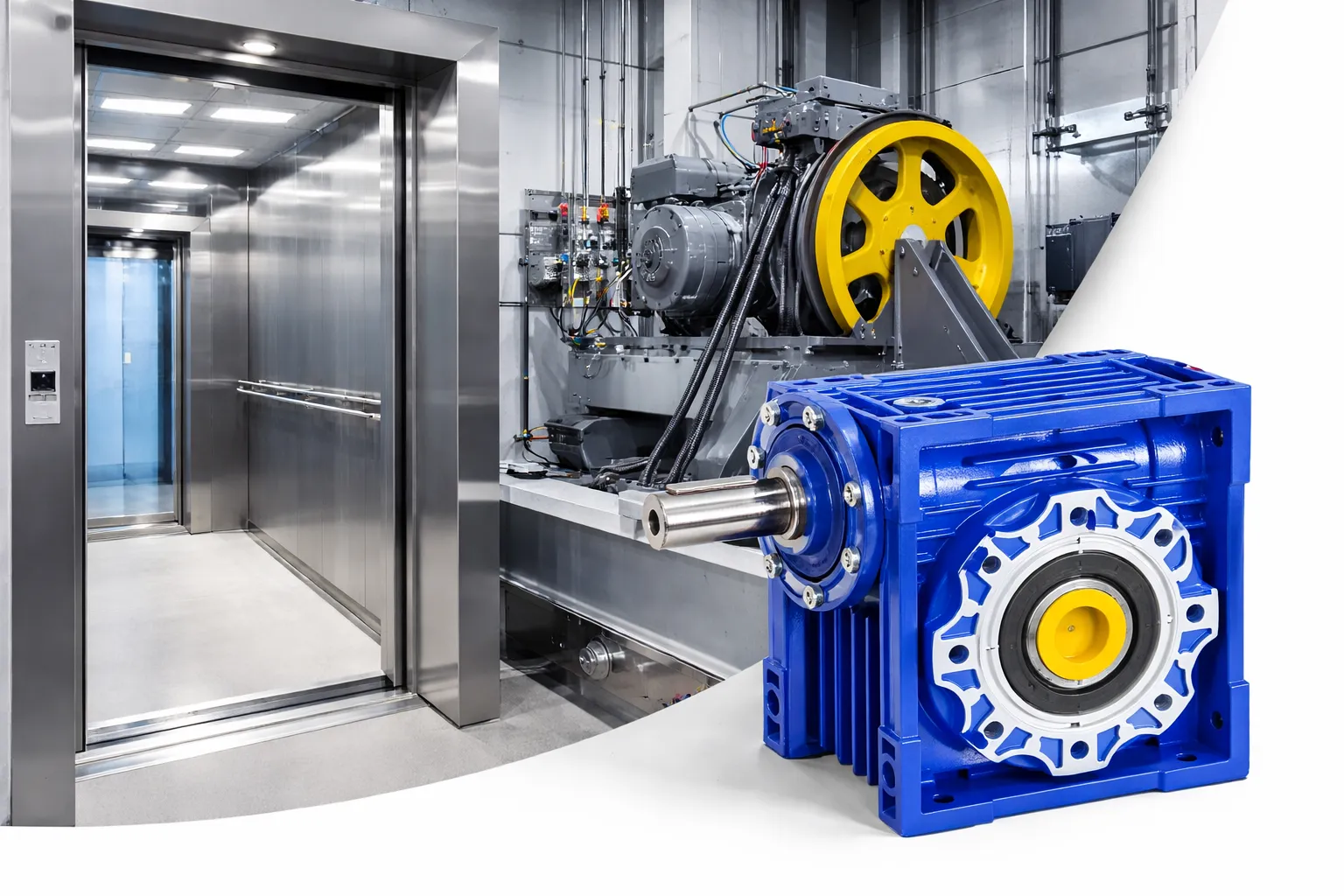
This is why a Schneckengetriebe becomes the natural default for hoist and lift applications despite having lower efficiency than helical or planetary alternatives. The worm drive’s inherent self-locking behavior at appropriate gear ratios is exactly the property a hoist designer needs. Rather than adding a separate electromechanical brake to hold the load when power is removed, the reducer itself provides the static load-hold capability — reducing the number of components, failure points, and maintenance tasks in the drive system.
The second distinct characteristic of hoist drives is the load direction. Gravity acts continuously on the suspended mass regardless of motor state. The reducer output shaft sees a persistent torque trying to rotate it in the lowering direction even when the motor is de-energized. For a Schneckengetriebe, this means the self-locking property must work reliably under static load — not just under the brief dynamic conditions during deceleration.

How Worm Gear Self-Locking Works — and What Can Undermine It
The Physics: Lead Angle vs Friction Angle
The worm thread wraps around the worm shaft at an angle to the shaft axis — this angle is called the lead angle. At a high gear ratio (80:1 or 100:1), the thread is almost perpendicular to the shaft, so the lead angle is very shallow, typically below 2 degrees. At a low ratio (10:1 or 15:1), the thread spirals more aggressively and the lead angle is steep — 8 to 12 degrees.
Self-locking happens when this lead angle is smaller than the friction angle at the worm-wheel contact surface. The friction angle is equivalent to the friction force — it is determined by the coefficient of friction between the hardened steel worm and the bronze worm wheel running in oil. For a correctly lubricated worm drive, this friction angle sits between 3 and 5 degrees under normal operating temperatures.
When the lead angle is below the friction angle, any torque applied to the output shaft from the load side cannot push the worm thread backward — the friction force is greater than the tangential force trying to reverse the drive. The result is a mechanically locked position that holds without motor power or an external brake.

Self-Locking Reliability by Gear Ratio
| Übersetzungsverhältnis | Ungefährer Vorhaltwinkel | Self-Locking Under Static Load | Recommendation for Hoist Use |
|---|---|---|---|
| 10:1 | 8 – 12° | NEIN | Back-drivable; always use external brake |
| 15:1 | 5 – 8° | NEIN | Back-drivable; always use external brake |
| 20:1 | 4 – 6° | Marginal | Cold only; unreliable at operating temperature — external brake required |
| 30:1 | 3 – 4° | Generally reliable | Minimum ratio for light-duty hoists; confirm at operating temperature |
| 40:1 | 2 – 3° | Zuverlässig | Suitable for most factory and warehouse hoist applications |
| 60:1 | 1.5 – 2° | Sehr zuverlässig | Standard ratio for most industrial hoists and material lifts |
| 80:1 – 100:1 | Under 1.5° | Äußerst zuverlässig | Preferred for inclined drives and applications where safety margins must be maximum |
Two Factors That Can Reduce Self-Locking Reliability
Temperature and oil viscosity. As the worm drive runs under load, the mesh friction generates heat. The oil warms up, its viscosity drops, and the friction coefficient at the contact surface decreases. At 70–80°C operating temperature — common in continuous-duty hoist applications — the friction angle can drop by 1 to 2 degrees compared to cold conditions. A Schneckengetriebe that self-locks reliably at ambient temperature may not self-lock reliably after one hour of continuous lifting cycles. This is why borderline ratios (20:1 to 25:1) should never be relied upon for load-hold in an unattended hoist.
Vibration and dynamic loading. Static self-locking relies on friction overcoming the load’s tangential force at the worm thread. Under continuous vibration — from adjacent machinery, building structure, or the load swinging on the hook — dynamic forces momentarily exceed the static friction threshold, causing gradual creep in the lowering direction. This mode of failure is slow but cumulative and may not be apparent until the load has shifted 20–30 mm from the intended position.
Critical note: Selbstverriegelnd in einem Schneckengetriebe is a mechanical convenience for operational load-hold — it is not a certified safety device for personnel lifting applications. Any hoist that could carry personnel, or where a dropped load would create a safety hazard, requires an independent certified mechanical brake sized to the full load regardless of the reducer’s self-locking ratio.
Complete Sizing Calculation: Step by Step
The following worked example uses a factory cantilever hoist lifting 300 kg at a speed of 0.15 m/s. Each step in the selection process is shown with the reasoning behind the parameter choice — not just the arithmetic.
| Step | Parameter | Calculation | Result |
|---|---|---|---|
| 1 | Lifting force | F = m × g = 300 × 9.81 | 2,943 N |
| 2 | Output torque at drum (drum radius = 80 mm) | T = F × r = 2,943 × 0.08 | 235 N·m |
| 3 | Service factor (moderate shock, 8 hr/day hoist) | SF = 1.5 (hoist standard, daily use) | SF = 1.5 |
| 4 | Design torque (before ratio selection) | T_design = 235 × 1.5 | 352.5 N·m |
| 5 | Required output speed (n = v / (2π × r)) | v = 0.15 m/s, r = 0.08 m → n = 17.9 rpm | ≈ 18 rpm |
| 6 | Required gear ratio (motor at 1,450 rpm) | i = 1,450 / 18 = 80.6 → select 80:1 standard | i = 80:1 |
| 7 | Motor power required (P = F × v, with SF) | P = 2,943 × 0.15 × 1.5 / 0.80 (efficiency) = 828 W → 1.1 kW motor | 1.1 kW |
| 8 | Frame selection (WP90 at 80:1, rated ~950 N·m output) | 950 N·m rated > 352.5 N·m design ✓ | WP90, 80:1 |
| 9 | Self-locking confirmation | Ratio 80:1 → lead angle ≈ 1.2° < friction angle ≈ 3.5° ✓ | Self-locking ✓ |
The WP90 cast iron Schneckengetriebe at 80:1 carries a 2.7× margin on output torque (950 N·m rated versus 352.5 N·m design). This margin accounts for startup spikes, occasional overload, and the 20–30% torque increase that occurs during the first few lift cycles when the drum rope accumulates and the effective radius changes. For continuous-duty industrial hoists, a margin of 2× to 3× is standard practice.
One check often skipped: the thermal power rating. At 80:1 with 80% efficiency, the reducer dissipates approximately 20% of input power as heat. For the WP90 at 1.1 kW input, that is 220 W of continuous heat generation. Confirm that the thermal power rating of the selected frame exceeds this value — or verify that the hoist’s duty cycle provides sufficient cooling time between lifts.
Failure Modes in Hoist Reducers — Causes, Signs, and Prevention
Hoist drives fail in predictable patterns. Most failures are preventable if the signs are recognized before the damage becomes structural. These four modes account for the majority of unplanned failures in Schneckengetriebe used on industrial hoists:
Overheating from Repeated Lift Cycles
Cause: Each lift cycle generates heat at the worm mesh. On a hoist with short cycle times — lifting, lowering, returning, repeat — the heat generated can exceed the housing’s ability to dissipate it, particularly in confined spaces without ambient airflow.
Diagnostic sign: Housing surface temperature consistently above 80°C during the operating day; oil appears dark or smells burnt at the next change.
Prevention: Size the thermal power rating against the full duty cycle, not just peak torque. Add a fan-cooled motor and specify synthetic lubricant if duty is heavy. Allow minimum 15-minute cool-down between intensive work periods on standard duty units.
Bearing Early Failure from Axial Overhang
Cause: The drum or sprocket weight creates an overhung radial load at the output shaft. If the drum diameter is large or its center is positioned far from the reducer face, the radial load on the shaft bearing can exceed the rated Fr value in the datasheet.
Diagnostic sign: Premature bearing noise (rumbling or periodic click) within the first 300–500 hours; shaft seal leak from bearing deflection under load.
Prevention: Mount the drum as close to the reducer face as possible. Verify the combination of hoist rope tension and drum weight against the rated Fr and Fa values. Use a support bearing on the opposite side of the drum from the reducer if the span is long.
Worm Wheel Wear from Contaminated Lubricant
Cause: Dust, water, or metal particles entering through degraded shaft seals contaminate the lubricant. Bronze worm wheel material is softer than the steel worm and shows wear first. Contaminated oil accelerates this wear significantly.
Diagnostic sign: Bronze-colored particles in oil at the change interval; gradual increase in output shaft play over operating hours.
Prevention: Maintain IP rating integrity — check shaft seal condition annually, replace if hardening or cracking is visible. Change oil at the first 500-hour interval regardless of appearance, then on the standard schedule. Monitor oil color at each inspection.
Gradual Self-Locking Degradation
Cause: Over years of operation, worm wheel tooth surface wear reduces the contact area, the worm surface loses some of its hardness advantage from repeated contact stress, and the effective friction coefficient decreases. Self-locking margins that were adequate at initial commissioning become borderline after several thousand operating hours.
Diagnostic sign: Slow load drift observed when the hoist is at rest under full load; this may only be noticeable over 10–15 minutes on a stationary suspended load.
Prevention: For hoists used daily for 3 or more years, add a scheduled static load-hold test at the annual inspection — hold rated load for 30 minutes and verify zero movement. If drift is observed, reduce the working load or add an external brake before further use.
Industry Standards and Documentation Requirements for Hoist Drives
Hoist and crane manufacturers in Korea and export markets typically work under ISO 4301 or FEM class classifications that define the mechanical loading class of the hoist mechanism. For a Schneckengetriebe installed in these systems, two documentation requirements typically apply: the reducer’s rated output torque and safety factor at the installation ratio, and confirmation of the self-locking ratio and test temperature.
Material traceability — worm shaft material specification, worm wheel alloy grade, and surface treatment documentation — is standard for export hoist equipment sold into EU markets under the Machinery Directive. Cast iron housing hoists may additionally require a housing pressure test certification for applications in harsh environments.
For industrial hoists operating within Korea, the Occupational Safety and Health Act regulations for lifting equipment require that the drive system be specified with a safety factor of at least 5 against breaking load for personnel-accessible areas. This affects the overall system design but specifically influences the rated capacity documentation required for the Schneckengetriebe in the hoist certification file. Kontaktieren Sie unser Ingenieurteam. for documentation support on certified hoist applications.

Three Hoist Applications That Illustrate Different Drive Requirements
Factory Cantilever Hoist — Light Industrial
Anwendung: 250 kg capacity cantilever jib hoist in an automotive parts manufacturing plant in Gyeonggi-do, South Korea. 6-meter boom, approximately 15–20 lifts per shift, 2 shifts daily. Clean, dry indoor environment.
Reducer configuration: WP70 cast iron Schneckengetriebe, ratio 60:1, 0.75 kW motor, drum diameter 120 mm. Output torque design value 155 N·m, rated value 450 N·m — margin of 2.9×.
Self-locking note: The 60:1 ratio provides reliable self-locking at operating temperature. No external brake was installed. After 2,600 hours of service (approximately 14 months), the annual inspection showed zero measurable load drift on a 30-minute static hold test at 250 kg.
Construction Material Hoist — Outdoor, Dusty
Anwendung: Temporary material hoist at a high-rise construction site in Seoul, lifting building materials to 18 floors. Maximum load 400 kg, operating in outdoor conditions through summer monsoon and winter cold.
Reducer configuration: WP100 cast iron Hochleistungs-Wurmreduzierer, ratio 80:1, 1.5 kW motor. IP55 sealing for dust and rain exposure. Drum mounted on external support bearing to manage the 400 kg + bucket weight as radial overhang load.
Note on external brake: Korean occupational safety regulations for construction site hoists require a certified load-holding brake independent of the reducer. A 240 V electromagnetic brake was mounted on the motor shaft. The WP100 self-locking provides the operational hold between lifts; the electromagnetic brake provides the certified safety hold during maintenance and after shift.
Bühnenplattformlift – leise, präzise
Anwendung: Bühnenlift in einem Zentrum für darstellende Künste in Daejeon, Südkorea. Die Plattform trägt 350 kg schwere Bühnenelemente und muss einen Höhenunterschied von 2,4 Metern zwischen Boden und Bühnenebene überwinden. Der Betriebsgeräuschpegel darf während der Proben 48 dB(A) nicht überschreiten.
Reducer configuration: WP90 Gusseisen SchneckengetriebeÜbersetzungsverhältnis 60:1, 1,1 kW VFD-gesteuerter Motor für sanftes Anfahren/Stoppen und Geräuschreduzierung beim Beschleunigen. Synthetisches ISO VG 220-Schmiermittel für geringere Geräuschentwicklung im Schneckengetriebe.
Ergebnis: Der gemessene Geräuschpegel in 3 Metern Entfernung vom Antrieb während der Plattformbewegung betrug 44 dB(A) – innerhalb der geforderten 48 dB(A). Die Anlaufgeschwindigkeit des Frequenzumrichters von 4 Sekunden bis zur Volllast eliminierte mechanische Anlaufgeräusche. Die Selbsthemmung mit einem Übersetzungsverhältnis von 60:1 hält die Plattform zwischen den Signalen geräuschlos auf Bühnenhöhe.
Häufig gestellte Fragen – Auswahl von Hebezeug- und Hubkraftreduzierstücken
Wie kann ich den Selbsthemmungskoeffizienten eines bestimmten Schneckengetriebes überprüfen?
Welches Wartungsintervall wird für ein Schneckengetriebe eines Hebezeugs empfohlen?
Kann ein Schneckengetriebe die Bremse eines Personenaufzugs ersetzen?
Welche Frühwarnzeichen deuten darauf hin, dass ein Reduzierstück am Hebezeug überprüft werden muss?
Kann ich einen Frequenzumrichter mit einem Schneckengetriebe für Hebezeuge verwenden?
Welche Informationen sollte ich bei der Anfrage eines Angebots für ein Hebezeug-Reduzierstück angeben?
Benötigen Sie ein Schneckengetriebe, das für Ihre Hebezeuganwendung geeignet ist?
Teilen Sie uns Ihre Hubkraft, Geschwindigkeit, Betriebsdauer und Umgebungsbedingungen mit – wir bestätigen Ihnen die richtige Lösung. Schneckengetriebe Rahmen, Verhältnis, Selbsthemmungskoeffizient und Dokumentationsanforderungen innerhalb eines Werktages. Als spezialisierter Hersteller von SchneckengetriebenWir können sowohl Standard-Hebezeugkonfigurationen als auch kundenspezifische Antriebsspezifikationen unterstützen.
Herausgeber: Cxm