औद्योगिक स्वचालन के लिए वर्म गियर रिड्यूसर
Automation engineers sometimes default to planetary or servo-integrated drives without asking whether the application actually needs that level of precision and cost. This guide defines where a वर्म गियर रिड्यूसर is the correct choice in automation drives — and where it genuinely is not — along with the technical data to make that distinction confidently.
The Precision Spectrum in Automation Drives: Where Worm Drives Sit
Industrial automation covers a range of positioning requirements from ±5 mm on a material handling gate to ±0.01 mm on a precision CNC worktable. These applications do not all need the same reducer. A harmonic drive that achieves near-zero backlash in a surgical robot axis is genuinely overkill — and overpriced — on a solar panel tracking system that only needs to hold a sun angle to within 0.5 degrees.
ए वर्म गियर रिड्यूसर occupies a specific and useful segment of this precision spectrum. It is not the right answer for all automation applications, but for the correct subset — low output speed, unidirectional or infrequently reversed, right-angle layout, moderate precision, cost-sensitive — it routinely outperforms more expensive alternatives on every criterion that actually matters for the application.
Understanding where the boundaries of that subset lie is more useful than a general comparison of specifications. The following two sections define those boundaries honestly — including the cases where a वर्म गियर स्पीड रिड्यूसर is not the right tool.


Where Worm Gear Reducers Fit in Automation — and Where They Don’t
Applications Where a Worm Gear Reducer Belongs
The positioning requirements are ±0.5 mm or looser, the drive direction is primarily one-way or infrequently reversed, the output speed is below 100 rpm, and a right-angle drive layout is either required or convenient. Examples: solar tracker azimuth axis, automated gate or barrier drive, packaging speed control section, greenhouse rack drive, indexing turntable with large angular steps (30 degrees or more).
In these applications, a standard वर्म गियरबॉक्स meets the positioning requirement at a fraction of the cost of a planetary or harmonic solution, with the added benefit that self-locking holds the position when power is removed — which eliminates a powered position-hold requirement from the motion control system.
Applications Where a Different Reducer Is More Appropriate
High-frequency reciprocating motion — more than 100 direction reversals per hour — generates cyclic thermal loading at the worm-wheel mesh that helical or planetary drives handle better. Backlash-sensitive bidirectional positioning where accumulated angular error needs to stay below 0.05 degrees cannot be reliably achieved with a standard वर्म गियर रिड्यूसर over its service life, as tooth wear gradually increases backlash.
Applications requiring output torque above 3,000 N·m in a compact housing are also outside the typical worm reducer envelope — this is where multi-stage helical, spiral bevel, or industrial planetary drives are more practical. For all of these cases, the cost premium of the alternative is justified by the performance requirement, not by marketing preference.
| Automation Condition | वर्म गियर रिड्यूसर | Helical / Planetary | Decision Logic |
|---|---|---|---|
| Output speed < 60 rpm, right-angle needed | Preferred | Needs added bevel stage | Worm simpler and lower cost |
| Position hold when power off required | Preferred | Needs powered hold or brake | Worm self-locking eliminates brake |
| Repeatability required < 0.05° | Use VRV030 AR class only | Standard helical or planetary | Standard worm insufficient; precision class needed |
| High-frequency bidirectional, > 150 rev/hr | Not recommended | Planetary or helical preferred | Thermal cycling limits worm drive life |
| Cost is a primary constraint | Strong advantage | 2× – 5× higher cost typically | If worm meets requirements, cost saves are significant |
VRV030 Precision Worm Gear Reducer: Technical Breakdown
For automation applications that need better positional accuracy than a standard वर्म गियर रिड्यूसर provides, the VRV030 precision series offers three backlash grades within the same compact aluminum housing. Each grade represents a measurable commitment from the manufacturing process — not just a marketing designation.
Three Backlash Classes Explained
Standard Class (≤ 0.24°): Produced with standard gear cutting tolerances and assembly clearances. Suitable for automation drives where the positioning requirement is ±0.5 mm or looser at the output shaft. Solar tracking, gate drives, and speed control sections fall into this range.
Class A (≤ 0.13°): Tighter gear cutting tolerances and selective assembly — mating worm and wheel pairs are measured and matched rather than randomly assembled. This halves the backlash of the Standard class. Suitable for rotary indexing tables, label and print registration drives, and moderate-precision servo-motor pairings.
Class AR (≤ 0.066°): The highest precision grade in the VRV030 range. Achieved through matched-pair manufacture with an additional preload adjustment. The 0.066° backlash is approximately 4.4 arc-minutes — approaching the entry threshold of precision harmonic drives at a significantly lower price point. Used for collaborative robot wrist joints, dispensing head drives, and laboratory instrument positioning.
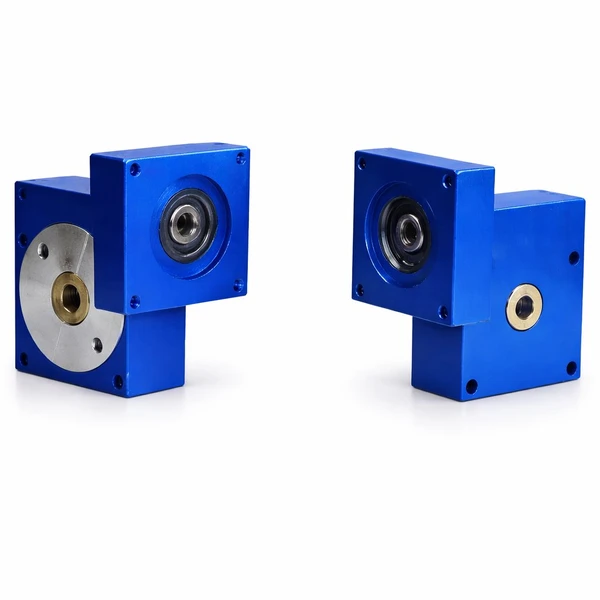
Pairing VRV030 with Servo and Stepper Motors
The VRV030 worm gear motor or reducer accepts IEC motor flanges and shaft inputs compatible with standard NEMA and IEC servo motor bolt patterns through an adapter. For servo applications, the VRV030’s reflected inertia should be checked against the servo amplifier’s inertia ratio specification — a large gear ratio significantly reduces the reflected load inertia, which can improve servo response but may require adjusting the amplifier’s velocity loop gain to avoid oscillation at the new, lower inertia condition.
For stepper motor applications where position is controlled in open loop (no encoder), the VRV030’s self-locking at appropriate ratios eliminates the powered holding current requirement when the motor is stationary — extending motor thermal life and reducing power consumption. The step angle resolution at the output is the stepper’s step angle divided by the gear ratio: a 1.8° stepper at 30:1 produces 0.06° per step at the output shaft.
Browse the VRV030 series and full worm gear reducer range for backlash class specifications and dimensional drawings.

Four Automation Applications That Show the Selection Logic in Practice
Solar Tracking System — Azimuth Drive
Why worm reducer: The azimuth axis rotates 180 degrees per day with no speed reversal. Output speed is 0.25 rpm maximum. The sun angle needs to be held to within ±0.5 degrees — well within standard वर्म गियर रिड्यूसर backlash. Self-locking at 60:1 holds the panel position without powered hold at night or during cloud cover. The right-angle layout matches the typical drive shaft orientation in panel support structures.
Selected configuration: NMRV063 at 60:1, 0.12 kW motor, IP65 for outdoor installation. The total drive cost per tracking axis was 64% lower than an equivalent planetary solution that had been previously used by the same installer.
Automated Packaging Dispenser — Quantity Control
Why worm reducer: A dispenser metering a fixed number of tablets or capsules per container operates at 12–18 rpm output with short, intermittent cycles (typically 1–2 seconds per container). Position accuracy required: ±1 full disc revolution (360°). Standard वर्म गियरबॉक्स backlash of under 0.5° is negligible against this requirement. Self-locking holds the dispenser disc position between cycles without a powered brake.
Selected configuration: NMRV040 at 40:1, 0.18 kW motor, stainless output shaft for pharmaceutical environment. Viton seals for IPA washdown cleaning procedures. The hollow shaft output eliminated the coupling between the reducer and the dispenser disc shaft.
Collaborative Robot Wrist — Precision Servo Axis
Why precision worm reducer: A low-payload collaborative robot arm’s wrist rotation axis needs compact right-angle geometry, a 30:1 to 50:1 ratio for torque multiplication, and backlash below 0.1° for repeatable positioning at the end effector. The VRV030 AR class (≤ 0.066°) meets all three requirements at significantly lower cost and weight than an equivalent harmonic drive assembly.
Selected configuration: VRV030 Class AR, ratio 40:1, paired with 100W servo motor. The self-locking at 40:1 eliminates powered holding torque at rest positions, reducing the thermal loading on the servo motor during extended stationary periods.
Laboratory Instrument — Precision Sample Positioning
Why worm reducer: A laboratory sample carousel requires quiet operation (below 40 dB(A) at 0.5 m), small physical footprint, and accurate angular indexing at 15-degree or 30-degree step intervals. The output speed is 2–5 rpm, making the worm drive thermally light. Anodized aluminum housing provides the corrosion resistance needed for laboratory cleaning agents.
Selected configuration: VRV030 Class A at 50:1 with a high-resolution stepper motor. Measured noise at 0.5 m: 37 dB(A) during indexing. The 0.13° Class A backlash translates to a linear positioning error of ±0.11 mm at a 50 mm carousel radius — within the ±0.2 mm sample positioning tolerance required by the instrument specification.
Precision Worm vs Harmonic Drive vs RV Reducer: The Honest Trade-Off
These three reducer types serve overlapping but distinct segments of the automation precision market. The comparison below focuses on properties that actually affect drive selection decisions — not headline specifications that rarely represent operating conditions:
| कारक | Worm Gear Reducer (VRV030 AR) | Harmonic Drive | RV (Cycloidal) Reducer |
|---|---|---|---|
| प्रतिक्रिया | ≤ 0.066° (AR class) | ≤ 0.010° – 0.020° | ≤ 0.020° – 0.040° |
| क्षमता | 72 – 82% | 80 – 85% | 85 – 92% |
| Self-locking (position hold) | Yes (at ratio ≥ 20:1) | नहीं | नहीं |
| Shock / impact resistance | Good | Poor (flex spline damage risk) | उत्कृष्ट |
| समकोण आउटपुट | मानक | Inline only | Inline only |
| Relative price (same ratio/torque class) | न्यून मध्यम | उच्च | Very High |
| Best automation fit | Right-angle, moderate precision, cost-sensitive, outdoor or chemical environment | Ultra-precision, inline axis, light load, clean environment | High torque, high shock, industrial robot joint, inline |

Backlash Impact Calculation: How Much Does Reducer Backlash Actually Affect Your System?
The angular backlash number in the datasheet only becomes a positioning error when the motion reverses direction. In unidirectional applications — where the drive always approaches a setpoint from the same side — backlash has no effect on repeatability at all. When bidirectional positioning is required, the backlash translates into a linear error at the end effector or output mechanism.
Two examples make the scale of this effect concrete:
The worm mesh geometry determines how lead angle, friction angle, and gear ratio interact to define both self-locking behavior and the effective backlash at the output shaft. For a given frame size and ratio, backlash is controlled at manufacture through gear cutting tolerance class and assembly clearance — the three VRV030 grades represent measurably different points on this manufacturing precision scale.
| Example Application | Standard (0.24°) | Class A (0.13°) | Class AR (0.066°) | Typical Tolerance |
|---|---|---|---|---|
| Lead screw, 5 mm pitch (linear positioning) |
0.0033 mm | 0.0018 mm | 0.0009 mm | ± 0.05 mm |
| Rotary table, 300 mm radius (edge position error) |
1.26 mm | 0.68 mm | 0.35 mm | ± 0.5 mm |
| Robot arm, 600 mm reach (end effector position error) |
2.51 mm | 1.36 mm | 0.69 mm | ± 1.0 mm |
Reading the table: for the lead screw application, all three VRV030 backlash classes are well within the ±0.05 mm tolerance — Standard class is adequate and the Class AR premium is not necessary. For the robot arm at 600 mm reach against a ±1.0 mm tolerance, Standard class is too loose, Class A is borderline, and Class AR is the correct choice.
This is the practical use of the backlash calculation — it removes the guesswork from backlash class selection. If you know the drive geometry (output radius or lead screw pitch) and the required positioning tolerance, the class that meets the requirement can be selected analytically rather than by conservative over-specification. हमारी इंजीनियरिंग टीम से संपर्क करें if you need a calculation for a specific drive geometry.
Frequently Asked Questions — Automation Worm Gear Reducer Selection
How do I measure the backlash of a worm gear reducer after installation?
Does the VRV030 Class AR worm gear reducer need special lubricant?
How does temperature affect the backlash of a precision worm gear reducer?
How long does the VRV030 backlash class remain within specification over service life?
What supply capability is available for VRV030 in automation OEM volumes?
Need a Worm Gear Reducer for Your Automation Application?
Share your output speed, torque, required positioning accuracy, and environment — we will confirm whether a standard वर्म गियर रिड्यूसर, a VRV030 precision unit, or a different configuration best matches your application, along with the technical data to support your design decision. As a specialist वर्म गियर रिड्यूसर निर्माता, we support automation OEM projects from prototype through production volume.
संपादक: सीएक्सएम