Worm Gear Reducers for Winches and Cable Drums
Selecting the right worm gear reducer for winch and cable drum applications requires understanding specific torque calculation principles that differ from standard conveyor or agitator selection. Winch drives demand a worm gear reducer that delivers sustained low-speed traction force, holds position reliably under load, and survives years of outdoor and marine exposure. This guide covers the selection calculation and specification decisions that determine whether a winch drive performs or fails.
Winch Drives vs Hoist Drives: A Different Application Profile
The hoist and lift application primarily concerns vertical load suspension — the worm gear reducer self-lock prevents dangerous drop when the motor is de-energized. Winch and cable drum applications have a different primary requirement: sustained horizontal or angled traction, bidirectional cable control, and outdoor environmental resistance over long periods.
Multi-layer cable buildup: As cable winds onto the drum in multiple layers, the effective drum radius increases continuously. The torque demand on the worm gear reducer increases proportionally. Selection must be based on the full-drum condition (maximum radius) — not the empty-drum condition.
Bidirectional operation: Most winches pull in and pay out cable. The worm gear reducer must transmit rated torque in both directions. Self-locking behavior applies only when stationary — during powered pay-out, the motor controls speed in both directions.
Outdoor and marine exposure: Winches are installed in demanding environments — vessel decks, construction sites, underground cable tunnels, coastal facilities. IP65 is the minimum specification. IP66 and anti-corrosion coatings are required for marine applications.

Core Selection Calculation for Winch Worm Gear Reducers
Winch worm gear reducer selection follows a specific sequence. The multi-layer cable condition makes the torque calculation critical — an error here causes the drive to be undersized at the worst possible moment: fully loaded drum.
Calculation Sequence
Step 1: Determine maximum line pull F (N) at full load. Include service factor: F_design = F_actual × SF (use SF 1.75–2.5 for winch duty).
Step 2: Calculate maximum drum radius r_max: r_max = core_radius + (wire_diameter × number_of_layers). Always use r_max, not core radius.
Step 3: Required output torque T = F_design × r_max (m).
Step 4: Drum rpm at full load: n_drum = (v × 1000) / (2π × r_max_mm). Use v = cable speed at full drum.
Step 5: Required ratio i = n_motor / n_drum.
Step 6: Confirm T_catalog ≥ T_required and verify thermal power for continuous duty.
Worked Example: Marine Survey Winch
Application: Hydrophone cable winch. Line pull 2,500 N, cable speed 8 m/min, drum core ø120 mm, wire ø8 mm, 4 layers. SF = 2.0.
r_max = 60 + (8 × 4) = 92 mm
F_design = 2,500 × 2.0 = 5,000 N
T_output = 5,000 × 0.092 = 460 N·m
n_drum = 8,000 / (2π × 92) = 13.8 rpm
Ratio = 1,450 / 13.8 = 105 → select 100:1
Selected: WP135 at 100:1, T_catalog 520 N·m > 460 N·m required. ✓
IP66, marine epoxy coating, VITON seals, PAO synthetic oil.
The multi-layer undersizing error: Engineers who calculate torque using the empty drum core radius — and find the worm gear reducer works when the drum is empty but stalls as the drum fills — have made this exact mistake. For a drum going from 60 mm core to 92 mm full radius, the torque demand increases 53%. Always calculate at r_max.

Why Worm Gear Reducers Are the Winch Industry Standard
Large Ratio, Single Stage
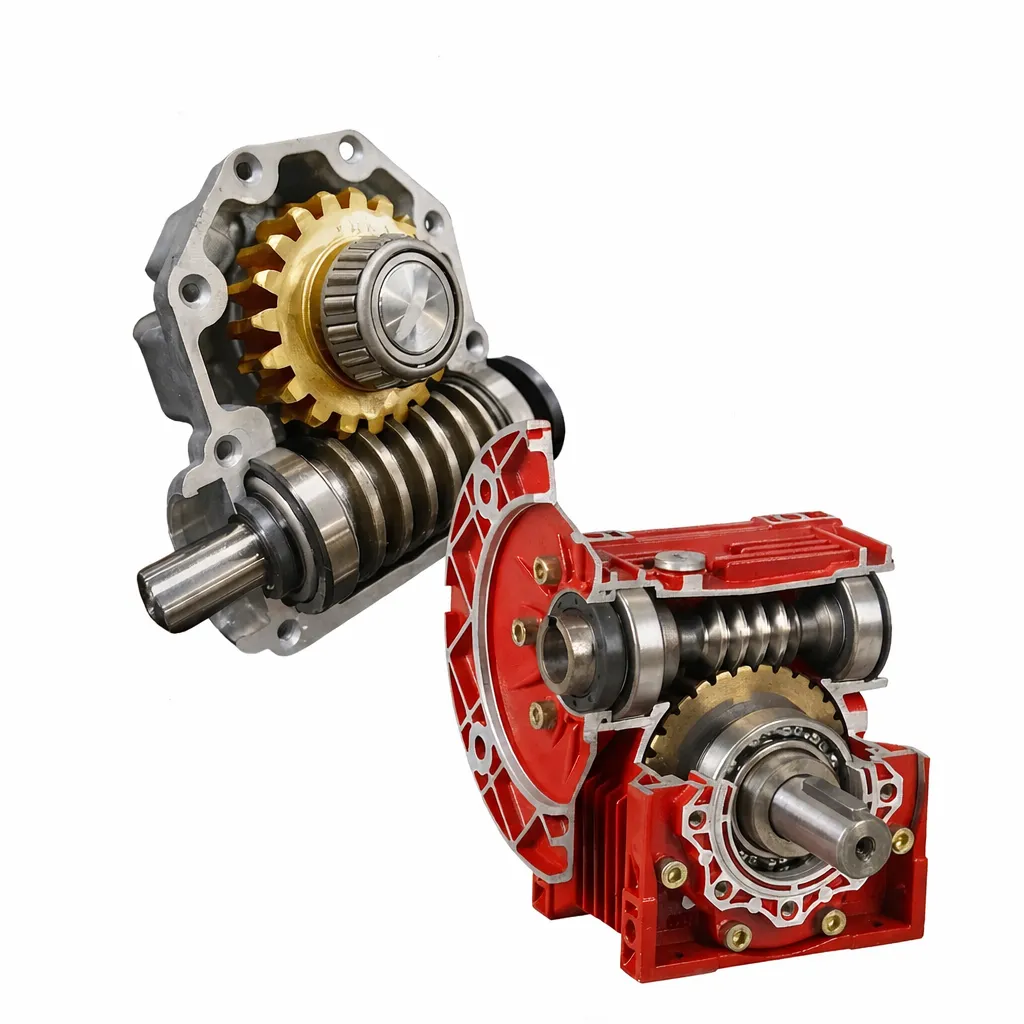
A single-stage worm gear reducer is the most compact and cost-effective way to achieve the large ratios needed for winch applications. Winch cable speeds (5–30 m/min) require large gear ratios (60:1–100:1) from a standard 1,450 rpm motor. A single-stage worm gear reducer achieves this in a compact package. Helical drives require two or three reduction stages to reach equivalent ratios.
Self-Locking Position Hold
At ratios above 40:1, the worm gear reducer self-locks when the motor is stopped — cable tension cannot back-drive the drum. This eliminates the need for a separate mechanical brake in many winch applications, reducing cost and complexity.
90° Right-Angle Drive
Winch drums are almost always driven at 90° to the motor axis. The worm gear reducer’s inherent right-angle geometry eliminates a separate bevel gear stage, reducing the drive train component count and the number of potential failure points.
Low Operating Noise
The sliding contact worm gear mechanism operates more quietly than spur or helical gear drives at equivalent torque and ratio — relevant for vessel deck winches where noise levels are regulated, and for underground or building installations where structure-borne vibration is a concern.
Protection Requirements by Application Environment
| Environment | Housing | IP | Special Requirements |
|---|---|---|---|
| Marine / offshore | Cast iron + marine epoxy | IP66 | SS fasteners, VITON seals, NSS >500h salt spray |
| Coastal outdoor | Cast iron + zinc-rich primer | IP65 | SS fasteners preferred; PAO synthetic oil |
| Mining underground | Cast iron + industrial epoxy | IP65 | EP gear oil; reinforced shaft seals |
| Construction site | Cast iron, standard paint | IP54 | Quarterly oil check; replace at project end |
| Indoor industrial | Cast iron or aluminum | IP54 | Standard specification; standard mineral oil |
The Multi-Layer Cable Problem: A Winch-Specific Engineering Challenge
As cable winds onto the drum in multiple layers, two things happen simultaneously that increase demand on the worm gear reducer as the drum fills:
Torque increases: The torque the worm gear reducer must provide equals line pull × effective radius. As each cable layer adds to drum diameter, the moment arm increases and required torque increases proportionally. A drum growing from 60 mm to 92 mm core radius requires 53% more output torque from the worm gear reducer for the same line pull — a difference that cannot be ignored at selection stage.
Speed changes: For the same cable linear speed, drum rpm decreases as the drum fills because the circumference grows. At constant motor speed and fixed reduction ratio, cable speed actually increases as the drum fills — the opposite of what most operators expect. In applications requiring controlled cable speed, this requires either a variable speed motor or accepting the speed variation.
Design rule: Always size the worm gear reducer for the full-drum condition. If correctly sized for full drum, it will be comfortably within limits at all intermediate loading conditions.
WP Series Selection Reference for Winch Applications
The following table provides a starting point for winch worm gear reducer selection based on approximate output torque and cable speed. Always apply SF 1.75–2.5 depending on winch duty cycle and shock loading before comparing catalog torque values. Apply SF 1.75–2.5 before comparing catalog torque to application requirement.
| WP Model | Max T₂ (N·m) | Ratio Range | Line Pull Approx (SF2, r=80mm) | Typical Winch Type |
|---|---|---|---|---|
| WP60 | 440 | 10:1–60:1 | ~2,750 N | Light survey / instrument winch |
| WP80 | 900 | 10:1–80:1 | ~5,600 N | Small anchor / mooring assist |
| WP100 | 1,750 | 10:1–100:1 | ~11,000 N | Marine workboat tow line / cable drum |
| WP135 | 3,500 | 10:1–100:1 | ~22,000 N | Mining tunnel cable reel / anchor winch |
| WP155 / WP200 | 6,000–12,000 | 10:1–100:1 | ~38,000–75,000 N | Heavy offshore / port mooring winch |
Three Winch Application Cases

Case 1: Marine Geophysical Survey Vessel
Requirement: Deploy and recover hydrophone streamer. Cable pull 2,500 N, 8 m/min, drum core ø150 mm, 6 cable layers, wire ø12 mm.
r_max = 75 + (12×6) = 147 mm; T = 3,000 × 2.0 × 0.147 = 882 N·m
Selected worm gear reducer: WP135 at 100:1, IP66, marine epoxy coating, stainless fasteners, VITON seals, synthetic PAO oil. NSS 500h salt spray test passed.
Case 2: Underground Cable Drum — Tunnel Boring Machine
Requirement: Power and communication cable take-up drum feeding a TBM as it advances. Cable speed 1.5 m/min, tension 800 N, continuous duty. IP65.
Selected worm gear reducer: WP80 at 80:1, IP65, EP oil. Self-locking at 80:1 holds cable when TBM is stationary without a separate brake.
Operating life: 22,000+ hours over 3-year TBM contract, zero seal failures.
Case 3: Construction Site Temporary Winch
Requirement: Material-pulling winch for high-rise facade installation, 6-month project, intermittent duty. Maximum load 4,500 N, 6 m/min cable speed.
Selected worm gear reducer: WP100 at 60:1, SF 2.0, IP54 cast iron. Standard mineral oil changed at project end.
Cost note: For temporary 6-month installations, a new standard worm gear reducer purchased for the project is more cost-effective than a higher-specification rental unit. Total worm gear reducer cost is a minor fraction of the facade installation contract value.
Frequently Asked Questions — Winch Worm Gear Reducers
When selecting a winch worm gear reducer, is ratio or output torque the more important starting parameter?
Can the self-locking feature completely replace a mechanical brake on a winch?
How often should seals be inspected on a marine winch worm gear reducer?
What is the most reliable connection method between the worm gear reducer output shaft and the winch drum?
Does bidirectional winch operation require a special worm gear reducer?
Can a winch worm gear reducer operate at -30°C in northern outdoor environments?
Winch and Cable Drum Worm Gear Reducer Supply
As a specialist worm gear reducer supplier, Korea Ever-Power provides winch and cable drum applications with WP series cast iron worm gear reducers in standard and marine-specification variants. Torque calculation support, dimensional drawings, and material certificates included with all orders. Browse our worm gear reducer range or contact our team with your winch parameters.
Editor: Cxm