Worm Gear Reducers for Solar Tracking Systems
A solar tracker worm gear reducer must hold panel position against wind loading without consuming power, survive 25 years of outdoor weathering with minimal maintenance, and move accurately enough to keep tracking error below 0.5°. This guide explains how to select and specify a worm gear reducer that meets all three requirements.
What Solar Tracking Demands That No Other Application Requires Simultaneously
Every worm gear reducer application involves some combination of torque, speed, and environment. Solar tracking is unusual in that it demands five specific properties that, taken together, are satisfied by the worm gear reducer uniquely well among standard gear drive options.
Tracking accuracy (±0.5°): The worm gear reducer must position the panel within ±0.5° of the target angle. Backlash — the free movement in the gear mesh — must be below approximately 0.3° to meet this target when accounting for system compliance and sensor accuracy.
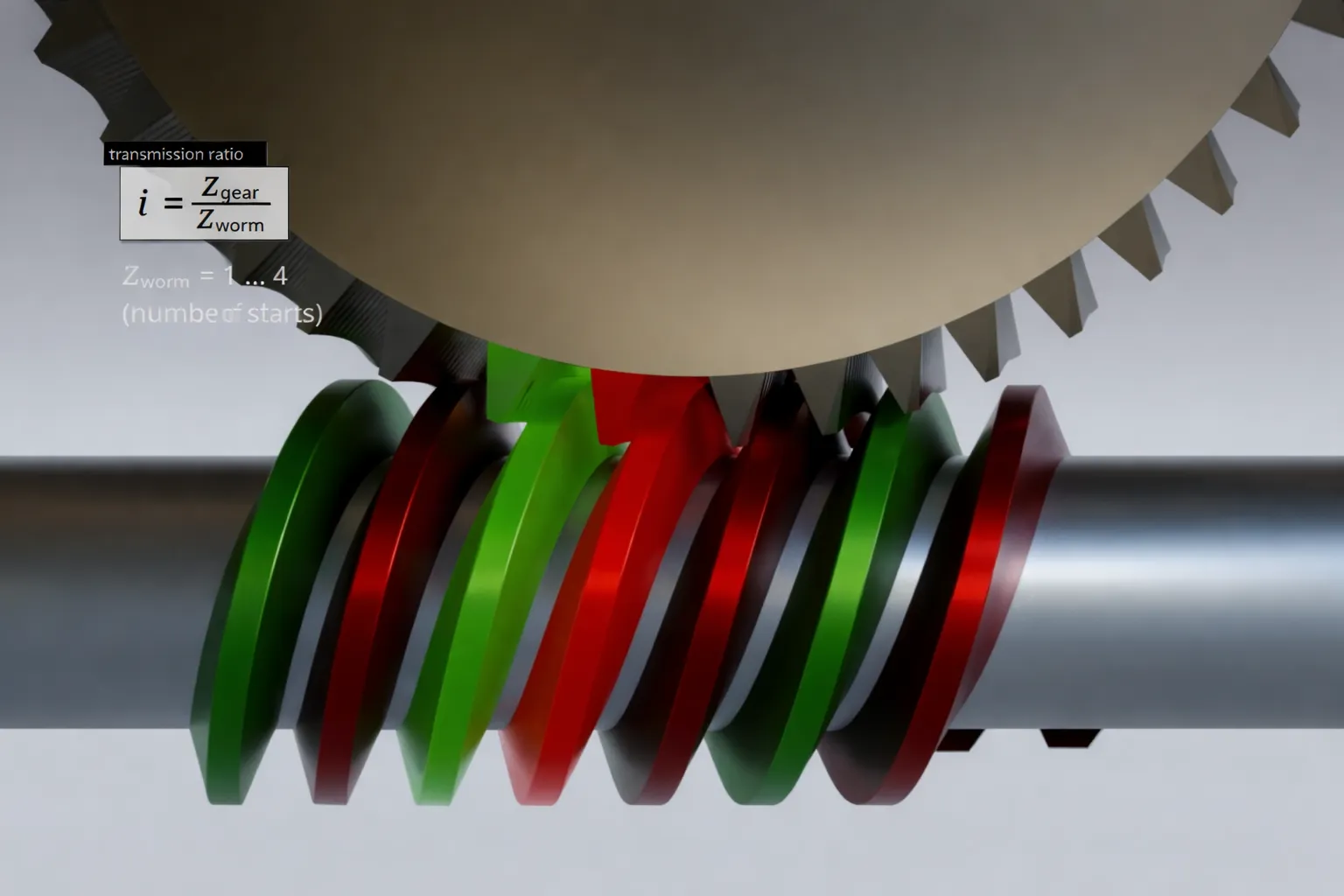
Self-locking position hold: When the motor is de-energized between tracking movements — which is most of the time — the worm gear reducer must hold the panel against wind loading without consuming power. This is the single most important function at night and during wind events.
Low energy consumption: The worm gear reducer efficiency is less critical here than for continuous industrial drives — a tracker moves only a few degrees per hour during the day. Energy consumed by tracking is typically 1–3% of energy generated. The self-lock function on the worm gear reducer eliminates the need for an energy-consuming electromagnetic brake.
25-year outdoor service life: Solar projects have a design life of 25 years. The worm gear reducer is expected to operate for this period with only periodic lubrication — not replacement. This places unusually demanding requirements on seal material, housing corrosion protection, and lubricant service life.
IP65+ all-weather outdoor protection: Korean rainfall, UV exposure, dust, pollen, and temperature swings from -15°C winter to +40°C summer — all standard outdoor Korean conditions — must be accommodated within the worm gear reducer specification.

Single-Axis vs Dual-Axis Tracking: Different Worm Gear Reducer Requirements
The most common solar tracker configurations require different worm gear reducer specifications because the torque and accuracy requirements differ significantly between tracking types.
| Tracker Type | Angular Movement | Typical Ratio | Recommended Series | Accuracy Req. |
|---|---|---|---|---|
| Single-axis horizontal (E–W, daily) |
0–180° daily, ~0.25°/min avg | 40:1–80:1 | NMRV050–NMRV090, or RV series | ±0.5° |
| Single-axis vertical (N–S tilt, seasonal) |
0–60° seasonal, intermittent | 60:1–100:1 | NMRV063–NMRV090 | ±1.0° (less critical) |
| Dual-axis (azimuth + elevation) |
Two independent axes, continuous precision | 60:1–100:1 each axis | VRV030 A-grade or NMRV reduced-backlash | ±0.1–0.2° |
| Agri-PV (agrivoltaic) | Single-axis with extra wind loading | 60:1–80:1 | NMRV090 or WP series (higher torque) | ±0.5° |
For the most common utility-scale single-axis horizontal trackers, the NMRV series aluminum worm gear reducer at 40:1–80:1 provides the best combination of lightweight design, thermal dissipation, and self-locking reliability.
Solar Tracker Torque Calculation: Wind Load, Gravity, and Friction
Torque Components
T_wind: Wind loading torque. Dominant in Korean conditions. For a single panel row 2 m × 6 m (12 m²), at Korean standard design wind speed 30 m/s: wind pressure q = 0.5 × 1.225 × 30² = 551 Pa. Moment arm to tracker axis ~0.5 m. T_wind = 551 × 12 × 0.5 = 3,306 N·m per row.
T_gravity: Gravity-induced torque from panel center-of-mass offset. For symmetric mounting, this is minimal when correctly balanced. In practice, allow 10–15% of T_wind as a gravity component.
T_friction: Bearing and seal friction in the tracker pivot. Typically 5–10% of T_wind at operating temperature.
T_total = T_wind + T_gravity + T_friction
Apply SF 2.0–2.5 for solar tracker worm gear reducers to account for wind gusts above design speed and long-term service life margin.
Worked Example: 1 MW Ground Station, Single-Axis
Configuration: 1 MW ground station, single-axis horizontal tracker. Each tracker drives one row of 12 panels (2 m × 6 m each = 144 m² total, but worm gear reducer drives 12 m² per segment).
T_wind = 551 × 12 × 0.5 = 3,306 N·m
T_gravity = 3,306 × 0.12 = 397 N·m
T_friction = 3,306 × 0.08 = 264 N·m
T_total = 3,967 N·m
SF 2.0 applied: T_design = 7,934 N·m
Motor speed 1,450 rpm, target tracking speed 0.25°/min = 0.00042 rpm at panel axis.
Ratio i = 1,450 / 0.00042 is unrealistically large — in practice, tracker is driven by a smaller stepper motor at ~60 rpm, giving i = 60/0.00042 = 142,000 — this confirms that a torque-multiplying gear train (not just one stage) or a direct slow drive is used. In practice, tracker gearboxes are designed as integrated units. Contact us for full tracker drive engineering.
Practical solar tracker worm gear reducer sizing note: For the most common utility-scale single-axis tracker segment (12–20 m² panel area), the NMRV090 at 60:1 driven by a 60W–120W stepper motor provides sufficient torque for Korean wind conditions with SF 2.0. For Jeju coastal locations or high-altitude mountain sites where design wind speed exceeds 35 m/s, step up to NMRV110 or NMRV150. Browse our worm gear reducer range for NMRV series specifications.
25-Year Outdoor Service Life: The Four Specification Requirements

1. Synthetic PAO Lubricant
Standard mineral oil degrades through oxidation and requires replacement every 2,000–4,000 hours. PAO synthetic oil has a service life of 8,000–10,000 hours and maintains lubricating properties across a wider temperature range (-40°C to +120°C). For a 25-year solar application, PAO oil with a 5-year service interval means only 5 oil changes over the project life — significant when multiplied across hundreds of tracker units.
2. VITON Shaft Seals
Korean outdoor conditions include UV radiation, ozone, and temperature cycling — all of which accelerate NBR seal degradation through hardening and lip cracking. VITON (FKM) seals resist ozone and UV aging, maintain elasticity from -40°C to +200°C, and are resistant to the PAO oil specified above. VITON shaft seals extend the expected seal service life from 5–8 years to 12–15 years in Korean outdoor conditions.
3. IP66 or Better
IP65 provides protection against water jets. Korean summers include typhoon-level rainfall events with horizontal rain at high velocity. IP66 (tested with high-power jets) provides the additional protection margin appropriate for solar tracker worm gear reducers in coastal or exposed locations. Specify IP66 as standard for utility-scale projects; IP65 is acceptable for building-integrated or sheltered installations.
4. Housing Corrosion Protection
Aluminum NMRV housings with standard anodizing or powder-coat finish are adequate for most Korean locations. For coastal sites within 3 km of the sea (Jeju, West Coast tidal zones), specify enhanced powder-coat over anodizing, or stainless steel housing variants. Salt-mist corrosion testing per ISO 9227 >500 hours is the acceptance criterion for coastal solar projects.
Korean Climate Specifications: What Changes vs Tropical Markets
Solar tracker worm gear reducers specified for subtropical markets (Malaysia, Vietnam, Middle East) may not be suitable for the Korean market without modification. The key differences:
Winter cold startup: Korean inland regions reach -15°C in January. A worm gear reducer filled with standard ISO VG 220 mineral oil at -15°C will have oil too viscous to flow adequately during the brief morning tracking movement. The motor must work against stiff oil — startup torque increases, and gear mesh receives poor lubrication during the first minutes of movement. Specify PAO ISO VG 150 (lower viscosity grade for cold conditions) or PAO ISO VG 220 with confirmed -40°C pour point for Korean winter service.
Summer heat: Panel temperatures in Korean summer can reach +75°C on the panel surface. The air temperature around the tracker drive is typically +35–45°C. PAO oil at VG 220 maintains adequate viscosity at +45°C — mineral VG 220 also works, but the PAO grade chosen for cold startup must also confirm adequate viscosity retention at +45°C. This is why PAO ISO VG 220 (not a lower-viscosity grade) is the balanced choice for Korean four-season conditions.
Typhoon wind events: Korean coastal areas are subject to annual typhoon events with sustained winds above 35 m/s and gusts above 45 m/s. The worm gear reducer self-lock must hold the panel against these loads. Design wind speed for Korean coastal solar projects is typically 35–40 m/s per KBC (Korean Building Code) seismic/wind zone maps. Confirm that the selected worm gear reducer torque capacity with SF 2.5 exceeds the calculated wind load at the design wind speed for the project location.
Large-Scale Solar Project Procurement: Volume Specification and Supply Planning


Volume estimation: A typical 1 MW ground-mounted single-axis solar project requires one worm gear reducer per 8–12 panels (depending on panel width and row length). A 1 MW project with 2,500 panels (400 W each) and 10-panel rows requires approximately 250 tracker drive units. A 50 MW project requires approximately 12,500 units.
OEM customization: For quantities above 500 units, Korea Ever-Power offers customized shaft configurations, modified flange patterns, and project-specific markings. Common solar tracker customizations include: hollow output shaft with specific bore and keyway dimensions, modified input shaft length for motor coupling, and project-specific corrosion protection specifications.
Delivery scheduling: Solar project timelines are driven by EPC contractor installation schedules. Korea Ever-Power supports phased delivery to match installation sequencing — rather than receiving all units at once and storing them on site. This reduces site storage requirements and ensures the units are not stored outdoors before installation.
Spare parts supply: For a 1 MW project, hold 2–3% spare worm gear reducers on-site (5–7 units) for the warranty period. After warranty, maintain 1% of site quantity as operational spare. Korea Ever-Power’s product range is maintained in production for minimum 10 years for each active model — spare units and worm wheel components are available on continuing supply.
Frequently Asked Questions — Solar Tracker Worm Gear Reducers
Is the low efficiency of a worm gear reducer a problem in solar tracking applications?
How do you verify that the worm gear reducer self-lock is sufficient to hold the panel against Korean typhoon winds?
What is the expected backlash of a standard NMRV worm gear reducer at 60:1, and is it acceptable for solar tracking?
Can one worm gear reducer drive a longer row of panels to reduce unit count?
What maintenance is required for solar tracker worm gear reducers over a 25-year project life?
Is a worm gear reducer suitable for agri-PV (agrivoltaic) installations where panels are higher off the ground?
Solar Tracker Worm Gear Reducers for Korean and Regional Projects
As a specialist worm gear reducer supplier, Korea Ever-Power provides solar EPC contractors and tracker OEMs with NMRV and WP series worm gear reducers specified for Korean climate conditions — PAO oil, VITON seals, IP66, cold-startup confirmation. Volume pricing, phased delivery, and OEM customization available. Browse our worm gear reducer range or contact our team with your project specifications.
Editor:Cxm