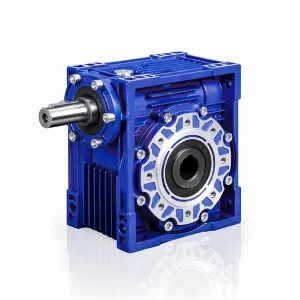
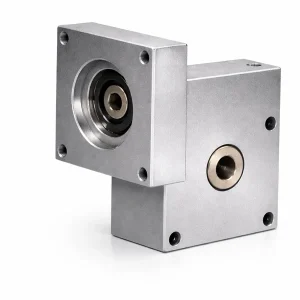
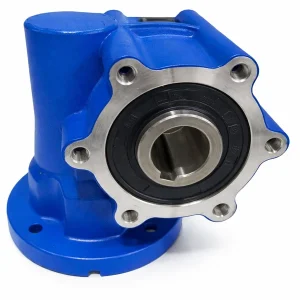
WPWDK 웜 기어박스 | WP 시리즈

WPWDK series worm gear reducer, HT200 grey cast iron housing, frame sizes WPWDK40 through WPWDK250. Output torque 6–3025 N·m, input power 0.12–15 kW at 1,500 rpm input. Ratios 10–60:1. Bearing options include C&U, NSK, and SKF. For textile, rubber, plastics, lifting, food packaging, metallurgy, petrochemical and stage machinery.
WPWDK Series Worm Gear Reducer — Cast Iron, 6–3,025 N·m, Frame WPWDK40–250
The WPWDK series is a cast iron WP-family 웜 기어 감속기 covering frame sizes WPWDK40 through WPWDK250, with output torque from 6 N·m (WPWDK40) up to 3,025 N·m (WPWDK250) at 1,500 rpm standard input speed. At the same power input of 0.12–15 kW, the torque range across the series achieves a 504:1 spread — from light-duty textile machine drives to heavy lifting and metallurgical equipment. The "DK" configuration designation indicates the specific shaft and mounting arrangement in the WP series family, distinct from the WPWO, WPWKO, and WPWT variants in the same family.
The housing material is HT200 grey cast iron throughout — the same alloy used across the WP series. HT200 provides the housing rigidity and vibration damping that aluminium alloy cannot match at output torques above 500 N·m. The self-lubrication properties of graphite-containing grey iron also mean that the housing will not gall or seize if lubrication is temporarily insufficient, providing a degree of operational margin that is not available with die-cast aluminium alloy housings.
Standard ratios are 10, 15, 20, 25, 30, 40, 50, and 60:1. Bearing options include C&U (domestic), NSK (Japanese), and SKF (European) — the choice of bearing brand can be specified at the time of order, which is useful when a plant has a standardised bearing supplier or when an OEM needs documentation to match an existing bearing specification. Synthetic lubricant is standard across the series.

Technical Specifications — WPWDK Series
| 매개변수 | 사양 |
|---|---|
| 유형 | WP series adaptable worm gearbox |
| Model / Frame Sizes | WPWDK40, 50, 60, 70, 80, 100, 120, 135, 155, 175, 200, 250 |
| 주택 자재 | HT200 grey cast iron |
| 입력 전력 | 0.12–15 kW (at 1,500 rpm input speed) |
| Output Torque Range (Series) | 6–3,025 N·m |
| 표준 비율 | 10, 15, 20, 25, 30, 40, 50, 60 |
| Bearing Options | C&U (domestic) / NSK (Japanese) / SKF (European) — specify at order |
| Seal Options | KSK / SKF — specify at order |
| 윤활유 | Synthetic (specified grade per frame size and duty in product manual) |
| 하우징 색상 | Blue / Green or on customer request |
| 보증 | 18 months from shipment |
| 품질 시스템 | ISO 9001:2015 |
| Application Sectors | Textile printing and dyeing; rubber and plastics; building materials; lifting machinery; food packaging; metallurgy; environmental protection; petrochemicals; stage machinery; new energy |
WPWDK Configuration — What the Designation Means
The WP series encompasses several different shaft and mounting configurations within the same cast iron housing family. Understanding the configuration suffix helps in selecting the correct variant for a specific machine layout. The primary WP series types that Korea Ever-Power supplies are: WPWO (universal mounting, single output shaft), WPWKO (vertical output shaft), WPWKT (with torque arm), and WPWDK (double keyed shaft — the DK indicates a shaft end configuration with keyway on both the input and output shafts, optimised for chain sprocket and coupling attachment).
The WPWDK is commonly specified in textile machinery where the gearbox output shaft drives a sprocket or gear directly via key-and-keyway — a direct, positive engagement without the need for a coupling hub. The input shaft similarly accepts a sprocket or belt pulley for non-direct motor coupling arrangements, which is the most common power input method in older textile plant designs and in many chemical processing drives where the motor is not co-located with the gearbox.
The American technology designation in the product description refers to the worm gear geometry and manufacturing process — cut worm profile with carburised and ground worm shaft — which follows design principles common in North American industrial gearbox manufacturing. This is contrasted with some lower-cost WP series products that use milled rather than precision-ground worm profiles. The precision-ground worm shaft produces lower mesh noise and longer worm wheel life through better load distribution across the tooth contact.
Why Engineers Specify the WPWDK Series
✦ 6–3,025 N·m in 12 Frame Sizes
The WPWDK40–250 frame series covers a 504:1 torque range from a single product family. A plant running both light tension drives and heavy lifting equipment can standardise on WPWDK and select the appropriate frame size for each drive — simplifying procurement, maintenance training, and spare parts management.
✦ Choice of NSK, SKF or C&U Bearings
Bearing brand specification at order is unusual for this price class of WP gearbox. For OEM builds that must document a specific bearing brand for CE or ATEX certification dossiers, or for plants that standardise on a single bearing supplier for stock management, the WPWDK's selectable bearing option provides an advantage over series where bearings are supplied as-procured without brand guarantee.
✦ HT200 Cast Iron — Durability Under Sustained Load
HT200 (300 MPa tensile strength, 190–240 HB hardness) provides the housing rigidity to maintain bearing centre distance under continuous radial and axial shaft loads. In textile machinery running multiple shifts per day for years, and in chemical agitator drives running 24/7, the housing must not creep, fatigue, or corrode in ways that affect gear mesh geometry.
✦ Stable Transmission — Below 50 dB(A)
Textile machinery operates in environments where machine noise accumulates across many drives running simultaneously. The below 50 dB(A) specification for the WPWDK series (consistent with the broader WP series specification) is achieved through the precision-ground worm shaft, matched bronze wheel profile, and the damping mass of the cast iron housing.
✦ Large Transmission Ratio in Single Stage
The WPWDK covers 10:1 through 60:1 in a single worm stage. Getting 60:1 reduction in a single compact stage from a 1,500 rpm motor down to 25 rpm output without the cost and complexity of a two-stage helical or helical-bevel gearbox is one of the defining commercial advantages of the worm gear principle in industrial machinery.
✦ 20:1 이상의 비율에서 셀프 락킹 기능 작동
For lifting machinery, gate actuators, and dyeing machine lid drives where the mechanism must hold position when power is removed, the WPWDK at 20:1 and above provides mechanical self-locking without a supplementary brake. At 30:1–60:1 the lock is reliable for the normal service temperatures and load levels encountered in these applications.
Industries and Applications
▸ Lifting Machinery, Metallurgy & Stage Equipment

Winch drives, goods hoists, stage rigging systems, and metallurgy transfer equipment in the 0.37–11 kW motor power class are common WPWDK applications. The cast iron housing rigidity and the worm gear's natural self-locking at 20:1 and above provide two layers of load-holding security: mechanical self-lock at the worm mesh, and the mechanical advantage of the worm ratio that limits back-drive torque at the input shaft. For stage machinery applications, the below 50 dB(A) noise specification matters — quiet operation is a practical requirement in theatre environments where an audible gearbox would affect audience experience during slow scene changes.
▸ Textile, Printing, Dyeing & Rubber Machinery
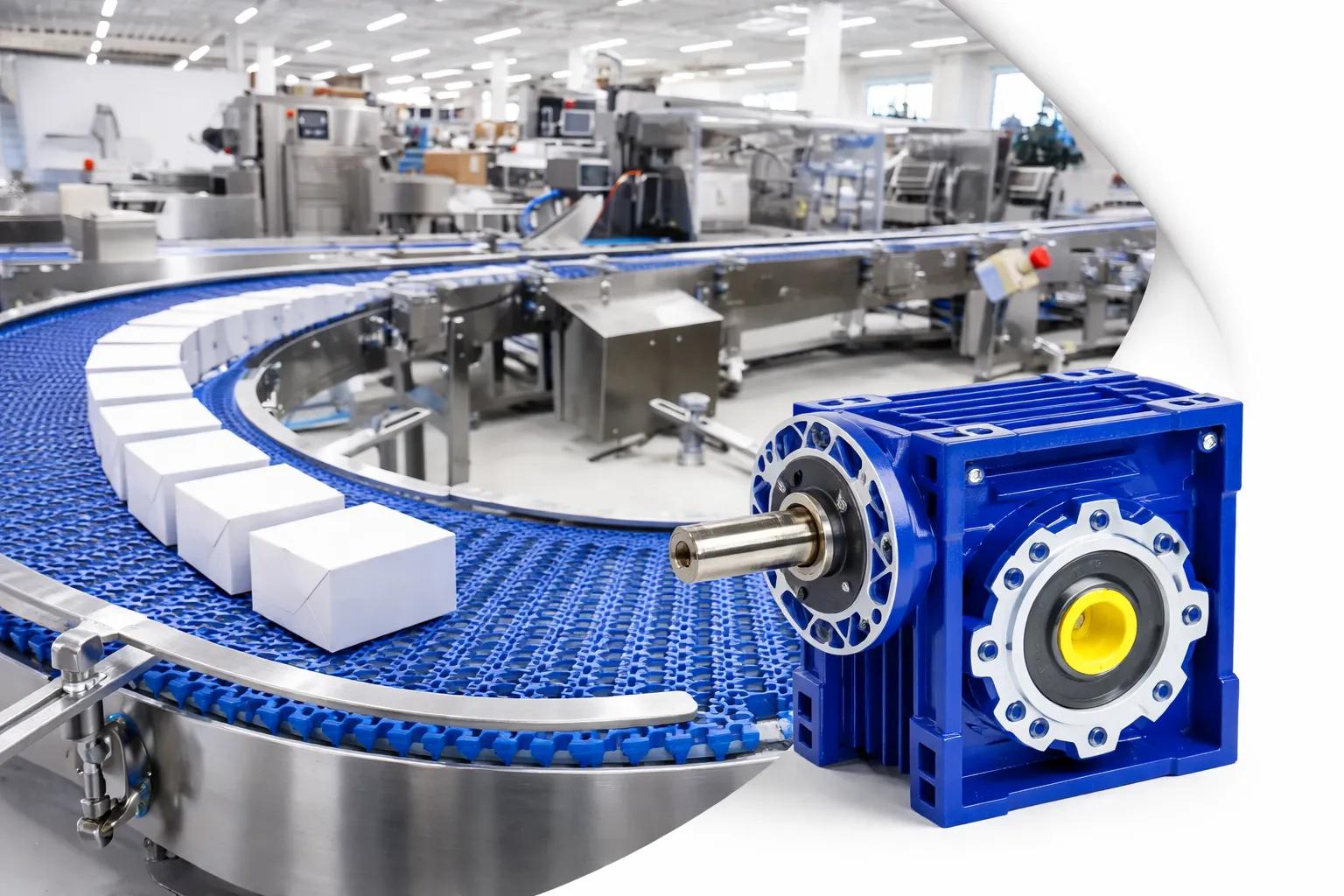
Textile machinery — rapier looms, knitting machines, stenter frames — uses dozens of individual drive points, each typically requiring 0.12–2.2 kW at 20–60 rpm output. The WPWDK's key-shaft output and input configuration matches the direct sprocket-drive arrangement common in textile mill installation practice, where motors and gearboxes are individually mounted and connected by short roller chain sections rather than solid-shaft coupled motor-gearbox units. Dyeing machines use similar drive configurations for slow rotation of fabric carriers and chemical agitators.
▸ Petrochemical, Environmental & New Energy Equipment
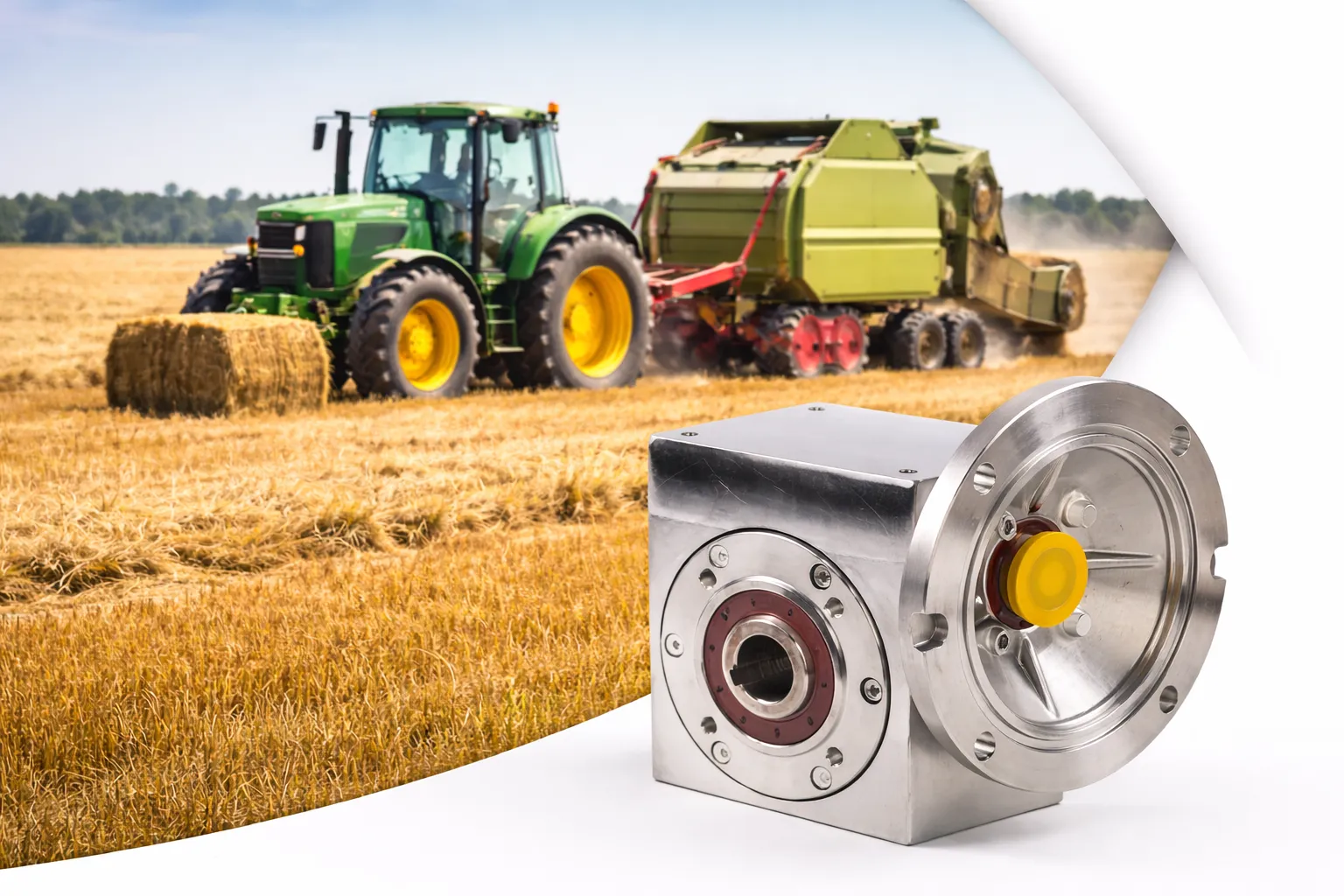
Chemical processing agitators, environmental machinery fan drives, wastewater treatment paddle drives, and wind power maintenance equipment all benefit from the WPWDK's combination of high torque range, self-locking safety, and multi-frame availability. Petrochemical drives often require documentation of bearing brand for ATEX equipment packages — the WPWDK's ability to specify NSK or SKF bearings allows the gearbox to be included in a certified equipment assembly without bearing brand discrepancies. New energy applications including solar mounting structure adjustment drives and small wind turbine auxiliary equipment are also covered. See the full 웜 기어 감속기 제품군 for all available series.
Frame Size and Bearing Brand Selection
Korea Ever-Power recommends the following selection process for the WPWDK series:
- ◉ Step 1 — Determine output speed requirement. At 1,500 rpm standard motor input, divide 1,500 by the required output rpm to get the ratio. Select the nearest standard ratio: 10, 15, 20, 25, 30, 40, 50, or 60. If exact speed is required and no ratio matches, a motor with VFD speed control will compensate ±15% around the nearest standard ratio.
- ◉ Step 2 — Calculate required output torque. Output torque = (motor power kW × 9,550) ÷ output rpm, then apply a service factor of 1.25–2.0 depending on shock load and duty cycle. Look up the WPWDK frame size whose rated output torque at the selected ratio exceeds the derated requirement.
- ◉ Step 3 — Specify bearing brand. C&U is the standard option and suitable for most general industrial applications. Specify NSK or SKF if: (a) your customer or certification body requires a named European or Japanese brand; (b) you are stocking bearings from a single supplier and prefer matching brands across all equipment; or (c) the application duty cycle (continuous heavy load, high temperature) makes the premium bearing brands' tighter internal clearance tolerances worth the modest price premium.
- ◉ Step 4 — Specify seal. KSK seals are standard. SKF seals offer marginally better oil retention at elevated temperatures and higher shaft speeds — specify SKF seals for drives running above 1,200 rpm output shaft speed or in ambient temperatures above 50°C.
For multi-frame orders across an entire production line, contact us via 한국 에버파워 with the full drive schedule — we can review the selection and provide a consolidated quotation with dimensional drawings for all frame sizes.
매칭 드라이브 부품
The WPWDK worm wheel is the first component to wear in long-service textile and industrial machinery. Sourcing the replacement wheel from Korea Ever-Power guarantees the same bronze alloy grade, bore dimensions, and tooth profile as the original — avoiding the common problem of a non-matching replacement wheel that produces accelerated wear from mismatched contact patterns.

⚙ 웜 휠 — 웜웜휠.탑
Bronze worm wheels for each WPWDK frame size, in the alloy grade and tooth profile matching the original production specification. Provide frame size (WPWDK40–250) and ratio at inquiry — we confirm centre distance, tooth count, and bore dimensions. Wheels are supplied as bare gear ring or press-fit to shaft.
⚙ 웜 샤프트 — 웜휠기어.탑
20CrMnTi alloy steel worm shafts for the WPWDK series, carburised and precision-ground, HRC 56–62. Stocked for standard WPWDK frame sizes and ratios. The worm shaft is the harder component in the mesh pair and typically outlasts multiple worm wheel replacement intervals — but should be inspected for surface pitting at each wheel change.
⚙ 샤프트 커플링
The WPWDK's keyed input and output shafts are primarily used with sprockets and gears rather than flexible couplings. If a flexible coupling is required between the gearbox output shaft and a driven load shaft in a direct drive arrangement (rather than chain/sprocket), pin-and-bush couplings are standard in the WP series torque range. Contact us with shaft diameters, keyway dimensions, and transmitted torque for a specific recommendation.
자주 묻는 질문
What is the difference between WPWDK and WPWO?
→ Both are HT200 cast iron WP series units in the same housing family. WPWO is the universal mounting variant with single output shaft and multiple foot/flange mounting options in one housing. WPWDK is the double-keyed shaft variant — the specific shaft geometry is designed for sprocket and gear direct-mount input and output, rather than IEC motor flange coupling. If you are direct-coupling a standard IEC motor, WPWO is usually the correct choice. If you are connecting via chain/sprocket or belt/pulley to both input and output, WPWDK is the appropriate variant.
What output speed does WPWDK give at 60:1 with a 1,450 rpm (4-pole 50 Hz) motor?
→ 1,450 ÷ 60 = 24.2 rpm. If using a 1,500 rpm nameplate speed motor, it is 25 rpm. For applications requiring exactly 25 rpm, the 60:1 WPWDK with a standard 4-pole motor gives this at rated load. If your motor runs at 1,440–1,460 rpm (typical no-load vs full-load slip range), the output speed will be between 24 and 24.3 rpm — acceptable for most industrial drives.
Can I specify NSK bearings in the WPWDK250 (largest frame)?
→ Yes. NSK bearing specification is available across the WPWDK40–250 size range. Specify "NSK bearings" clearly in the order — this is not the default and must be stated explicitly. For the WPWDK250 at maximum rated torque (3,025 N·m), the NSK premium bearings are a worthwhile specification because their tighter internal clearance tolerances reduce shaft deflection under high load, which helps maintain mesh geometry throughout the service life. The price premium for NSK in the WPWDK250 is modest relative to the total unit cost.
What does the 6 N·m minimum torque figure mean for WPWDK40?
→ The 6 N·m minimum is the output torque of the WPWDK40 (smallest frame) at its lowest power input — approximately 0.12 kW at 10:1 at 1,500 rpm input speed. This is a light-duty textile machine or thin-web printing press drive condition. The WPWDK40 is the entry point of the cast iron WP series; for applications that need even lighter torque in a compact unit, the aluminium RV or NMRV series would be more appropriate. The WPWDK's cast iron housing adds weight and cost compared to aluminium — at 6 N·m, that cost is harder to justify than at 300+ N·m.
How do I select between WPWDK and a helical-bevel gearbox for the same torque?
→ A helical-bevel gearbox at the same torque will typically be 15–25% more efficient and lighter for the same torque rating. The WPWDK's advantages over helical-bevel are: (a) single-stage high reduction — 60:1 from one stage vs two or three stages in helical-bevel; (b) natural self-locking at ratios ≥ 20:1 which eliminates a separate holding brake; (c) lower purchase cost in the 100–1,000 N·m torque range; (d) simpler right-angle shaft layout. If efficiency is the primary driver, helical-bevel is better. If single-stage high reduction, self-locking, and cost are the primary drivers, the WPWDK wins.
What is the recommended lubricant change interval for the WPWDK series in continuous service?
→ Change the oil at 100 hours for the first service (to flush run-in debris), then every 2,000–3,000 hours or 12 months in continuous industrial service. For higher temperatures (oil sump above 70°C) or chemical exposure, reduce the interval to 1,000 hours. After the first oil change, monitor the colour and viscosity of the used oil — dark colouring and bronze particles indicate accelerated worm wheel wear. If particles are present at the first standard change interval, investigate the load and alignment before proceeding to the next change.
고객들이 하는 말
Kim Jong-won, Plant Engineer, Daegu Textile Machinery Factory (2024)
"Running WPWDK80 units at 40:1 on our stenter frame drives — 24 units on a single machine. Specified NSK bearings to match our existing maintenance stock. After 18 months of three-shift operation, no bearing failures and no significant noise increase. First oil change at 100 hours showed expected bronze run-in particles; subsequent changes clean."
Park Myung-jin, Maintenance Manager, Incheon Chemical Plant (Q4 2024)
"Used WPWDK120 at 30:1 for a chemical agitator shaft in a medium-viscosity product vessel. Required SKF bearing documentation for our ATEX equipment register. Korea Ever-Power supplied the WPWDK with SKF bearings and provided the bearing model numbers on the delivery note. Simplifies our maintenance documentation considerably."
Choi Byung-geun, Equipment Engineer, Seoul Stage Equipment Co. (2025)
"WPWDK100 at 50:1 for a motorized flying rig drive on a touring show. The self-locking at 50:1 provides the mechanical position hold we need between cues. Noise level — critically important for us — measured below 48 dB(A) in our workshop before installation. Compact enough to fit the available truss mounting space."
Lee Yong-jae, Procurement Engineer, Gyeonggi-do Rubber Processing OEM (2024)
"Replaced an older German brand WP series unit with WPWDK155 at 20:1 on a rubber mixing line. The sprocket-drive input matched our existing drive chain arrangement exactly — no modification needed. Output torque was adequate for the revised mixing recipe load. Total replacement cost including labour was about 55% of the original European brand unit."
Han Jae-soo, Automation Engineer, Busan Food Processing Equipment Maker (late 2024)
"Specified WPWDK60 at 15:1 for a food packaging conveyor end-drive — belt speed was set by the mechanical ratio at rated motor speed. C&U bearings as standard were adequate for this duty. Delivery in 6 working days. All 8 units arrived within dimensional tolerance, no inspection rejects."
Yoon Seong-hoon, Project Manager, Daejeon Environmental Equipment Builder (Q1 2025)
"Used WPWDK200 at 40:1 for a wastewater paddle drive running continuously. HT200 housing handles the outdoor installation corrosion environment better than the aluminium units we tried previously. Two years in continuous service with one oil change — no housing corrosion or seal failure."
추가 정보
| 편집자 | Cxm |
|---|