Эффективность червячного редуктора: анализ с точки зрения инженера.
Every specification sheet shows an efficiency range for a червячный редуктор. Far fewer engineers know what determines where in that range their specific unit actually operates — or why the thermal power limit matters more than the mechanical torque rating for continuous-duty applications. This article covers both.
Efficiency Is the Inescapable Trade-Off in Worm Drive Selection
А червячный редуктор achieves high reduction ratios in a single stage, delivers right-angle output as standard, and provides inherent self-locking at appropriate ratios. These properties make it the correct choice for many industrial applications. The trade-off that comes with all three of these advantages is lower efficiency than a helical or planetary reducer at equivalent gear ratios.
This is not a manufacturing defect or a design limitation that can be engineered away — it is a fundamental consequence of the sliding contact mechanism that gives the worm drive its unique properties. The worm thread slides against the wheel tooth surface as they mesh. That sliding contact generates friction. Friction generates heat. Heat represents energy not delivered to the output shaft, which is the definition of efficiency loss.
Acknowledging this openly rather than minimizing it leads to better selection decisions. A червячный редуктор specified correctly for its efficiency characteristics will run reliably for years. One specified by ignoring the efficiency implications — undersized motor, ignored thermal rating, wrong lubricant — will fail predictably within months.
The efficiency characteristic also creates a direct link to two other important parameters: the thermal power limit (how much heat the housing can continuously dissipate) and the self-locking behavior (which depends on the same lead angle vs friction angle relationship that determines efficiency). Understanding all three together is what this article provides.
Five Factors That Determine Where in the Efficiency Range Your Unit Operates
The catalog shows a range — for example, 65–74% at 40:1. Where your specific installation lands in that range depends on five factors, each quantifiable and each within your control during the selection and installation phase.

Factor 1: Gear Ratio (The Dominant Variable)
Efficiency in a червячный редуктор is directly controlled by the lead angle of the worm thread. At a high ratio (80:1 or 100:1), the thread is nearly perpendicular to the shaft — a shallow lead angle. At a low ratio (7.5:1 or 10:1), the thread spirals more steeply — a larger lead angle. The fundamental efficiency formula shows the relationship clearly: efficiency increases as the lead angle increases relative to the friction angle between worm and wheel. Higher ratio means smaller lead angle means lower efficiency. This single relationship explains why a 10:1 worm drive can achieve 85–88% efficiency while a 100:1 unit from the same product family may only reach 55–62%.
Factor 2: Material Pairing and Surface Condition
The standard material combination in a червячный редуктор — hardened alloy steel worm shaft against tin-bronze worm wheel — is chosen because it provides favorable sliding friction characteristics. The bronze wheel material slightly conforms to the worm thread surface under load, increasing the contact area and reducing the peak contact stress. The friction coefficient of this pair in good lubrication conditions is approximately 0.05–0.09. Manufacturing precision directly affects this: a worm shaft ground to Ra 0.4 µm generates less friction than one finished to Ra 0.8 µm. Higher-quality units from reputable manufacturers consistently operate at the upper end of the efficiency range for this reason.
Factor 3: Lubricant Viscosity at Operating Temperature
The oil film between worm and wheel does two things: it reduces metal-to-metal friction (lower viscosity improves this) and it maintains a separating film under load (higher viscosity improves this). The ISO VG 220 standard fill is a compromise that works well across the typical operating temperature range of 40–70°C oil sump temperature. If the oil is too thin at operating temperature (wrong grade for high ambient), friction increases and efficiency drops. If the oil is too thick at cold startup, viscous drag losses are high until the unit warms up. Synthetic lubricants maintain a more consistent viscosity across a wider temperature range, which is why they often improve the operating efficiency of a червячный редуктор by 3–6% compared to mineral oil at the same specification.
Factor 4: Load Factor (Partial vs Full Load)
Efficiency in a червячный редуктор is not constant across the load range. The mechanical friction losses at the mesh have two components: a load-dependent component (which scales with torque) and a fixed no-load component (bearing drag, oil churning). At light loads, the fixed losses represent a larger fraction of the input, reducing efficiency. At full rated load, the load-dependent friction dominates and efficiency is closest to the catalog value. Operating continuously at 30–40% of rated torque can reduce actual efficiency by 3–7 percentage points compared to the catalog value at rated load.
Factor 5: Operating Temperature (Cold vs Warm)
A cold червячный редуктор starting from ambient temperature shows lower efficiency than the same unit at operating temperature. The thicker oil at cold temperature creates higher viscous drag losses. As the unit warms up, viscosity drops, the oil film behaves more ideally, and efficiency rises to the steady-state operating value. This means startup current for VFD-controlled drives is higher than the steady-state running current — relevant for VFD sizing on cold-start applications such as outdoor conveyors in Korean winters.
Efficiency Reference Table by Gear Ratio
| Передаточное число | Приблизительный угол наклона. | Efficiency Range (mineral oil) | Efficiency with Synthetic Oil | Self-Locking? |
|---|---|---|---|---|
| 7.5:1 | 17 – 22° | 88 – 92% | 90 – 94% | Нет |
| 10:1 | 9 – 12° | 84 – 88% | 86 – 90% | Нет |
| 15:1 | 6 – 8° | 79 – 84% | 81 – 86% | Нет |
| 20:1 | 4.5 – 6° | 74 – 80% | 76 – 83% | Маргинальный |
| 30:1 | 3 – 4.5° | 68 – 76% | 71 – 79% | Надежный |
| 40:1 | 2.5 – 3.5° | 64 – 73% | 67 – 76% | Надежный |
| 60:1 | 1.5 – 2.5° | 60 – 68% | 63 – 71% | Очень надежный |
| 80 – 100:1 | 1 – 2° | 55 – 63% | 58 – 66% | Высоконадежный |
Values represent typical ranges for standard NMRV/WP series worm gear reducers at rated load, operating temperature, and correct lubrication. Specific values should be confirmed from the product datasheet for final engineering calculations.
Worked Calculation: From Motor Power to Heat Dissipation
This example uses a real application: a chemical mixer driven by a 4 kW motor through a червячный редуктор at 40:1 ratio, running continuously at 35°C ambient temperature. The goal is to determine whether the thermal power limit is satisfied at this ambient temperature — the check that most engineers skip.
Step-by-Step Thermal Check:
Данный: Motor input 4 kW, ratio 40:1, efficiency at 40:1 = 68% (mineral oil, full load)
Step 1 — Output power: P_out = 4 × 0.68 = 2.72 kW
Step 2 — Heat generated: P_heat = 4 × (1 – 0.68) = 4 × 0.32 = 1.28 kW
Step 3 — Catalog thermal rating at 20°C ambient: P1th(20°C) = 1.6 kW (typical for NMRV090 at 40:1)
Step 4 — Correct for actual ambient (35°C): P1th(35°C) = 1.6 × (90–35) / 70 = 1.6 × 0.786 = 1.26 kW
Step 5 — Check: P_heat (1.28 kW) > P1th(35°C) (1.26 kW) → Thermal limit EXCEEDED by 1.6%
Solutions: (a) Synthetic oil → efficiency 71%, P_heat = 1.16 kW → Satisfied ✓; (b) Next frame size up (NMRV110) with higher thermal rating → Satisfied ✓; (c) Add cooling fan to motor housing → effectively extends thermal rating
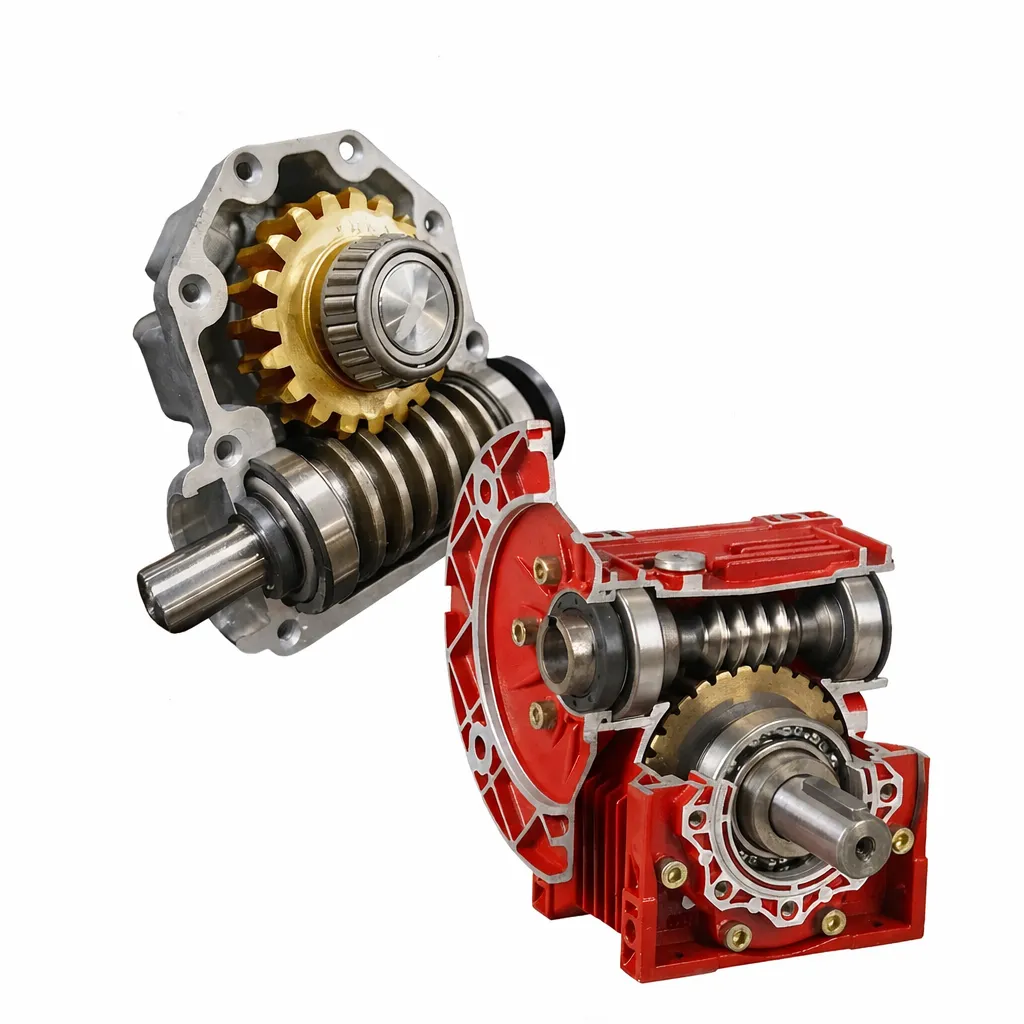
This calculation takes under five minutes with catalog data. The application at 35°C ambient with mineral oil is borderline — a 1.6% thermal overdemand that would show up as gradually increasing oil temperature over weeks of continuous operation. Switching to synthetic oil resolves the issue without any hardware change, at a lubricant cost difference of a few dollars per service interval.
The Thermal Power Limit: The Efficiency Constraint Most Engineers Miss
Every червячный редуктор catalog shows two power ratings: the mechanical power rating (the maximum torque the gear mesh can sustain without failure) and the thermal power rating (the maximum continuous input power the housing can dissipate as heat without exceeding the maximum oil temperature). For continuous-duty applications, the thermal power rating is the binding constraint — not the mechanical rating.
How Thermal Power Rating Works
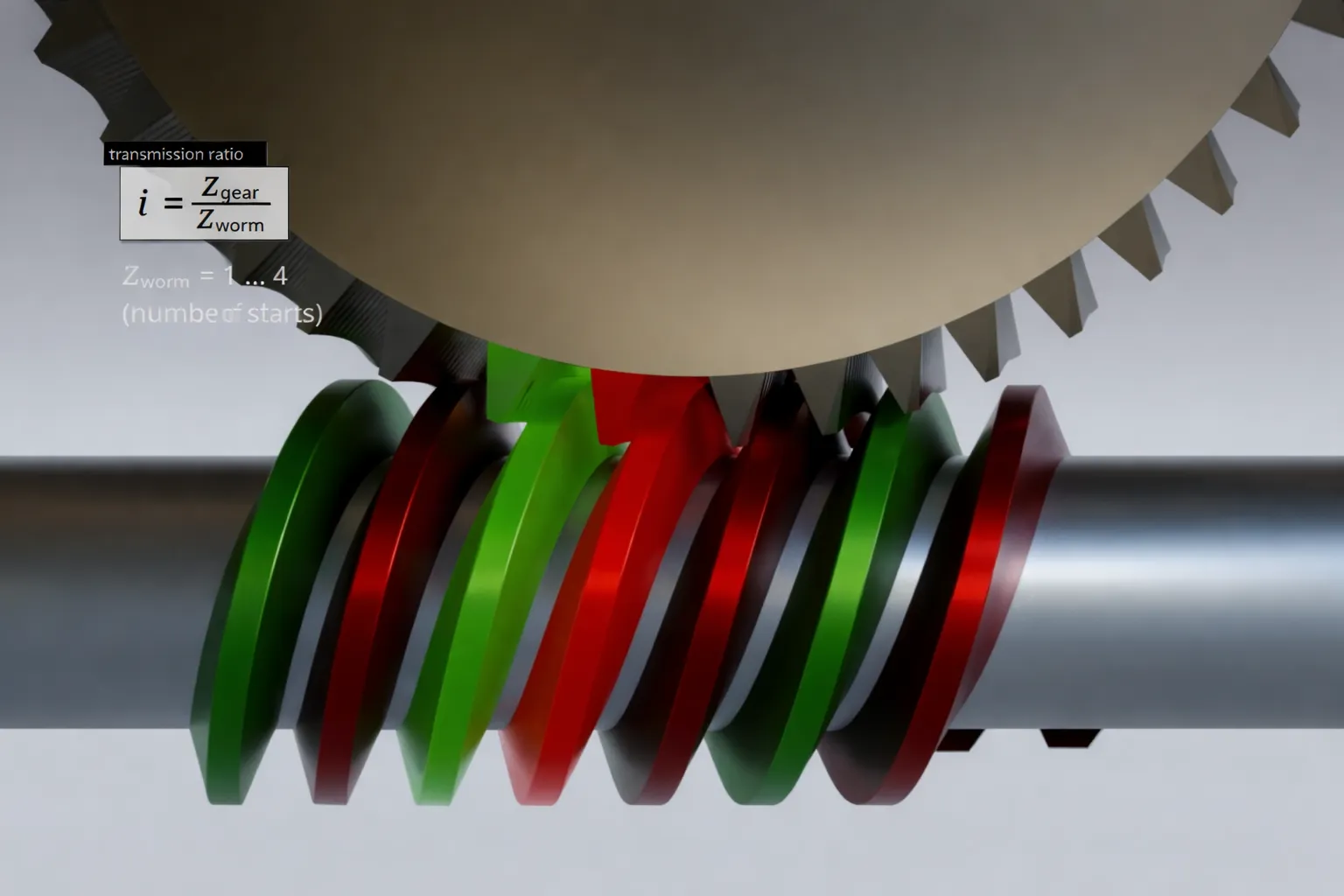
The heat generated by the червячный редуктор mesh must be conducted to the housing surface and then convected to the surrounding air. The thermal power rating P1th is the input power level at which the heat generated equals the heat dissipated — the steady-state balance point at the specified ambient temperature (usually 20°C).
If the actual heat generation exceeds P1th, the oil temperature rises continuously until it stabilizes at a point above the rated limit (typically 90°C for mineral oil). At elevated temperature, oil viscosity decreases, metal-to-metal contact increases, wear accelerates, and seal materials degrade. The failure process is gradual — not immediately catastrophic — which is why it goes unnoticed until a seal starts to leak or an oil sample shows contamination.
Ambient temperature correction: For every 5°C that ambient exceeds the 20°C reference temperature, the effective thermal power rating decreases by approximately 7%. At 40°C ambient, the correction factor is (90–40)/(90–20) = 71.4% of the catalog value. A червячный редуктор with P1th = 2.0 kW at 20°C provides only 1.43 kW at 40°C.
Three Solutions When Thermal Power Is Insufficient
Solution A: Switch to Synthetic Lubricant
Synthetic ISO VG 220 reduces friction at the worm mesh by 3–6 efficiency points compared to mineral oil at the same operating temperature. Less friction = less heat = lower thermal demand. This is the lowest-cost solution and requires no hardware changes. It is the first option to try when the thermal calculation shows a marginal excess.
Solution B: Select the Next Frame Size
A larger housing has more surface area and more thermal mass. The next frame size up for the same ratio and load will have a higher P1th that may satisfy the thermal requirement even at elevated ambient. This adds cost but ensures margin at all operating conditions. Mechanical torque rating also increases, providing an additional benefit on shock-loaded applications.
Solution C: Add Auxiliary Cooling
A forced-air cooling fan mounted on the motor or a separate blower directed at the червячный редуктор housing significantly increases the heat transfer coefficient and raises the effective P1th. This approach keeps the existing unit size and is preferred when space constraints prevent a larger frame. Some catalog series offer factory-mounted cooling fans as optional accessories.
Five Engineering Measures That Improve Real Operating Efficiency
These measures go beyond selecting the right frame size. They address the operating conditions that determine where in the efficiency range the червячный редуктор actually runs in service.
1. Do not over-specify the gear ratio. Every point of additional ratio beyond what the application actually needs reduces efficiency. If a conveyor drive requires 35 rpm output and the calculated ratio is 41:1, selecting 40:1 is correct. Selecting 60:1 “for safety margin” reduces efficiency by 4–8 percentage points and generates 15–25% more heat per unit of output work — for no functional benefit.
2. Match lubricant viscosity to operating temperature range. ISO VG 220 is the standard recommendation for 20–40°C ambient. At ambient below 5°C (Korean winters, cold storage facilities), ISO VG 150 or a synthetic VG 100 may be more appropriate — thinner oil reaches the mesh faster at cold startup, reducing the duration of the inefficient cold-running period. Above 40°C ambient, ISO VG 320 or a synthetic VG 220 maintains the oil film under the reduced viscosity at high temperature.
3. Optimize mounting position to ensure splash lubrication. The standard oil fill level in an NMRV or WP червячный редуктор is set for horizontal mounting. If the unit is installed at an angle or inverted, the oil level mark no longer applies — the worm thread may run partially dry, increasing friction and reducing efficiency measurably. Check the manufacturer’s mounting position guidelines and adjust oil level for non-horizontal installations.
4. Design the duty cycle to allow thermal recovery. For applications where the worm gear reducer runs at high load intermittently (material handling hoists, intermittent process drives), designing in cooling time between heavy-duty cycles keeps the oil temperature in the efficient operating range. Running continuously at the upper thermal limit degrades both efficiency and service life. A 20% duty cycle reduction often enables a smaller frame size to cover the application thermal requirements.
5. Change oil at the correct interval. Mineral gear oil degrades under the combined action of heat, oxidation, and metal particle contamination from normal wear. Degraded oil shows both higher friction coefficients (reducing efficiency) and reduced film strength (increasing wear). The standard change interval of 2,000 hours for mineral oil in a червячный редуктор is based on normal conditions — high ambient temperature or continuous heavy load should reduce the interval to 1,500 hours. Synthetic oil extends the interval to 3,000 hours or more due to better thermal stability.

Efficiency vs Self-Locking: The Trade-Off That Cannot Be Avoided
Both efficiency and self-locking behavior in a червячный редуктор are determined by the same underlying physical relationship — the lead angle of the worm thread versus the friction angle at the contact surface. This creates a fundamental trade-off that cannot be eliminated by design.
Self-locking occurs when the lead angle is less than the friction angle — which is the condition that also reduces efficiency. A worm drive that self-locks reliably (lead angle ≈ 2°, ratio ≈ 60:1) operates at 60–68% efficiency. A worm drive that approaches 80% efficiency (lead angle ≈ 8°, ratio ≈ 15:1) is not self-locking at normal operating temperatures.
The approximate boundary: self-locking in a червячный редуктор is reliable when forward efficiency is below approximately 50%. Above 50% forward efficiency, the worm can be back-driven by the output load. This means selecting a high-efficiency worm drive for an inclined conveyor or hoist application and relying on self-locking is a specification error — the two objectives are mechanically incompatible at those efficiency levels.
| Application Need | Efficiency Priority | Самоблокирующийся | Correct Ratio Range |
|---|---|---|---|
| High efficiency, no load-hold needed | > 80% | Not available | 7.5:1 – 15:1 (or consider helical) |
| Moderate efficiency, some load-hold | 65 – 78% | Marginal to reliable | 20:1 – 30:1 |
| Self-locking priority, efficiency secondary | 60 – 70% | Reliable to very reliable | 40:1 – 100:1 — hoists, inclined conveyors, adjustment mechanisms |
The correct engineering decision is: start with the application’s self-locking requirement. If self-locking is needed, accept the efficiency that comes with the appropriate ratio and size the motor accordingly. If self-locking is not needed, the lower ratio and higher efficiency are available. Never try to achieve both in the same червячный редуктор selection — the physics prevents it.
Measured Efficiency: Cold Start vs Operating Temperature
Catalog efficiency values for a червячный редуктор represent steady-state performance at operating temperature. Cold-start efficiency is measurably lower — which affects motor sizing, VFD current limits, and startup duration. The following data represents typical measured values from run tests conducted under controlled conditions:
| Соотношение | Cold (15°C oil) | Warm (60°C oil) | Improvement |
|---|---|---|---|
| 10:1 | 81% | 86% | +5 pts |
| 20:1 | 70% | 77% | +7 pts |
| 40:1 | 61% | 68% | +7 pts |
| 60:1 | 55% | 63% | +8 pts |
Measured on NMRV series units at rated load. Mineral ISO VG 220. Warm-up period approximately 20–40 minutes for a unit starting from 15°C ambient at full rated load.
The 7–8 percentage point gap between cold and warm efficiency has a practical implication: motors sized on catalog (warm) efficiency values may trip the thermal overload during cold starts on high-ratio drives. For cold-climate outdoor applications — a common scenario in Korea’s winter months — motor sizing should use cold-start efficiency, not catalog efficiency. The extra motor capacity required is small (one standard motor frame size) but prevents nuisance tripping on cold mornings. Свяжитесь с нашей инженерной командой. for cold-start motor sizing support.

Frequently Asked Questions — Worm Gear Reducer Efficiency
How can I measure the actual efficiency of my worm gear reducer in the field?
Does synthetic lubricant genuinely improve worm gear reducer efficiency?
Why does efficiency decrease further when the worm gear reducer is lightly loaded?
Can I improve the efficiency of a worm gear reducer that is already installed?
What is the minimum acceptable efficiency for a worm gear reducer in an industrial application?
Should motor power be sized on mechanical torque or on thermal power limits?
Need Help with Worm Gear Reducer Efficiency and Motor Sizing?
Send us your application details — ratio, input power, ambient temperature, and daily operating hours — and we will provide a complete thermal power check, motor sizing confirmation, and lubricant recommendation for your червячный редуктор installation. As a specialist производитель червячных редукторов, we provide technical support as standard.
Редактор: Cxm