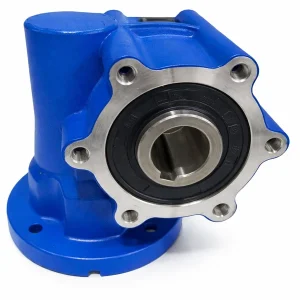
Šnekový převod VRV030 | Náhrada pro Ondrives Rino P70
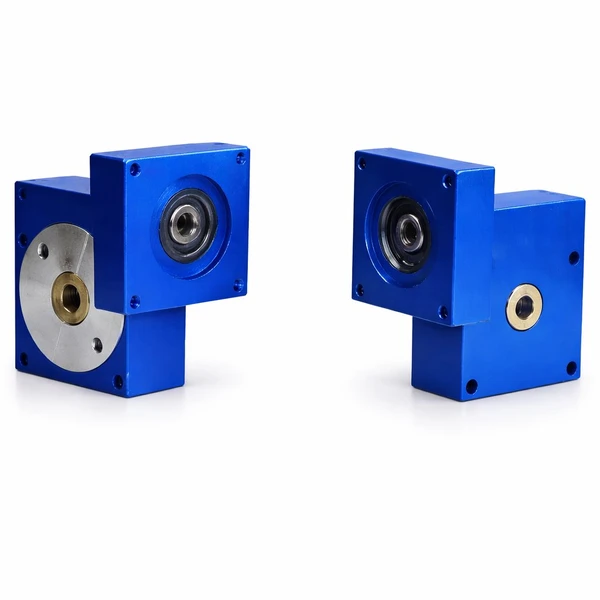
VRV030 large-frame worm gear reducer, 6.4 kg, Fr2=800 N, Fa2=600 N, Fr1=200 N. Ratio 10–120:1 with three backlash classes and per-ratio efficiency up to 90%. Reflected inertia 6.04×10⁻⁵ kg·m² at 10:1. Compatible replacement for Ondrives & Rino P70 series.
VRV030 Large-Frame Worm Gearbox — P70 Series, 6.4 kg, Fr2 800 N
The VRV030 P70 is the large-frame variant in the VRV030 precision šnekový reduktor series. At 6.4 kg with a maximum output radial load of 800 N and output axial load of 600 N, it is sized for large robot arm joints, antenna azimuth and elevation drives, satellite positioning mechanisms, and heavy automation actuators where the P45 (Fr2=450 N) is at or near its load limit. The P70's 200 N input radial load capacity also accommodates pulley-coupled and eccentrically-loaded input drives that would overload the P45's Fr1=60 N limit.
The ratio range of 10:1 to 120:1 is identical to the P45, and the efficiency data at each ratio is very close — 90% at 10:1, dropping to 50% at 120:1 (compared to 47% for P45 at 120:1, a marginal difference). The larger centre distance geometry of the P70 means the reflected inertia at input is approximately 6.04×10⁻⁵ kg·m² at 10:1 — roughly 10× that of the P45 at the same ratio, an important figure for servo tuning when replacing a P70 OEM unit or upgrading from a smaller frame.
Three backlash accuracy classes — standard (≤0.50°), A (≤0.13°), and AR (≤0.066°) — are available for every ratio. Shell Gadus S5 V4P 2.5 grease lubrication makes the P70 orientation-independent, which matters for the satellite and antenna positioning drives that make up a significant part of the P70's application base. The VRV030 P70 is an aftermarket-compatible replacement for the Ondrives & Rino P70 worm gear reducer.
Technical Specifications — VRV030 P70
Mechanical & Lubrication Parameters
| Specifikace | Value |
|---|---|
| Rozsah poměrů | 10:1 — 120:1 (7 standard steps) |
| Hmotnost | 6.4 kg |
| Nom. Input Speed [S1 T₂n] n1nom | 1,000 min⁻¹ (r/min) |
| Max. Input Speed n1max | 3,000 min⁻¹ (r/min) |
| Mazání | Grease — Shell Gadus S5 V4P 2.5 |
| Max. Operating Temperature | ≈ 60°C |
| Max. Input Radial Load Fr1 | 200 N |
| Max. Output Radial Load Fr2 | 800 N |
| Max. Output Axial Load Fa2 | 600 N |
P70 Series — Ratio, Efficiency, Backlash & Inertia Table
Suffixes: norma = backlash ≤0.50°; A = ≤0.13°; AR = ≤0.066°. Efficiency at nominal 1,000 rpm input. Reflected inertia at input in kg·m². Lead direction: Right Hand throughout.

Values are at nominal input speed, for guidance. Test in your application. Cooling may be needed at higher duty cycles or ambient temperatures.
Ratio Selection and Load Capacity Guidance

The P70 large centre distance allows the worm shaft to sustain much higher input shaft radial loads (200 N) than the P45 (60 N) or P15 (10 N). This matters when a timing pulley, gear, or belt drive is mounted on the worm shaft input — any eccentric load from the drive geometry contributes directly to Fr1. At 200 N, the P70 can accommodate a 2GT belt drive or small spur gear on the input shaft without approaching the radial load limit, whereas the P45 and P15 are essentially restricted to direct coupling inputs to stay within Fr1.
On the output side, Fr2=800 N at the P70 frame opens up applications that P45 cannot handle: a 5 kg robotic arm link at 0.25 m radius generates approximately 490 N of radial force at the wrist joint output shaft under 1g gravity load (neglecting dynamic effects) — which puts the P45 at Fr2=450 N over limit in the static case, but remains within the P70's 800 N limit with margin for dynamics. At the 10:1 ratio and 90% efficiency, the P70 is also well-suited to back-drivable joint designs in heavier collaborative robots.
The 120:1 P70 with 50% efficiency provides reliable static self-locking for vertical mechanisms. At 50% efficiency, the lock is marginally less secure than the P45's 47% at 120:1 (the P70 is 3 percentage points closer to the theoretical self-locking boundary) — in practice both are securely self-locking under the design static loads, but for safety-critical holding applications the static lock should always be confirmed experimentally under the actual load and temperature conditions of the installation.
Why the P70 Large Frame is Specified
Fr2=800 N is 1.78× the P45 and 10× the P15. At this load level, the P70 handles real industrial robot wrist joints, large antenna drive output shafts, and satellite panel slew mechanisms without the shaft bearing becoming the life-limiting component.
Fa2=600 N significantly exceeds the P45's 300 N. For vertical actuators where the output shaft sustains the weight of the driven load along its axis (not across it), Fa2 is the binding constraint — not Fr2. The P70 comfortably handles a 60 kg vertical load in the axial direction.
The P70's 200 N input shaft radial load limit opens up belt-drive and gear-drive input configurations that the P45 (Fr1=60 N) and P15 (Fr1=10 N) cannot handle. This flexibility in input drive arrangement is important in mechanical designs where direct coupling to the motor is not geometrically possible.
The 10× higher reflected inertia vs P45 at the same ratio means the servo motor sees a very different load inertia. When replacing a P70 OEM unit with the VRV030, or when substituting P70 for P45 in a redesign, the servo drive parameters must be retuned — the system will behave identically on paper but the actual gain settings will be different.
Achieving sub-0.1° backlash in a 6.4 kg gearbox with 800 N output radial load capacity is technically demanding — it requires precise worm profile grinding, controlled bearing preload, and housing bore accuracy. The P70-AR combines precision and load capacity in a single unit, eliminating the need for a separate precision stage preceding a load-rated speed reducer.
Field-deployed satellite and antenna drives are often solar-powered or battery-limited. The P70's 90% efficiency at 10:1 means a 100W motor delivers 90W of mechanical output — minimising the solar panel or battery capacity needed to perform a given number of positioning moves per day. For permanent military or observatory installations in remote locations, this matters.
Primary Applications
▸ Heavy Industrial Robotics & Large Robot Joints

Industrial robots with payload ratings of 10–30 kg use shoulder, elbow, and wrist joints that must sustain significant gravity and dynamic loads on the output shaft bearings. The P70 at 15:1 or 20:1 with class A or AR backlash covers this segment. At 20:1 (85% efficiency, Fr2=800 N, Fa2=600 N), a robot elbow joint carrying a 6 kg forearm plus a 5 kg end-effector generates output shaft radial loads in the 100–400 N range depending on arm configuration — well within the P70 envelope. For articulated robot bases using a worm gearbox for the base slew rotation, the 30:1 or 60:1 P70 provides suitable self-locking for safe stopping.
▸ Antenna Pointing, Satellite Positioning & Optical Drives
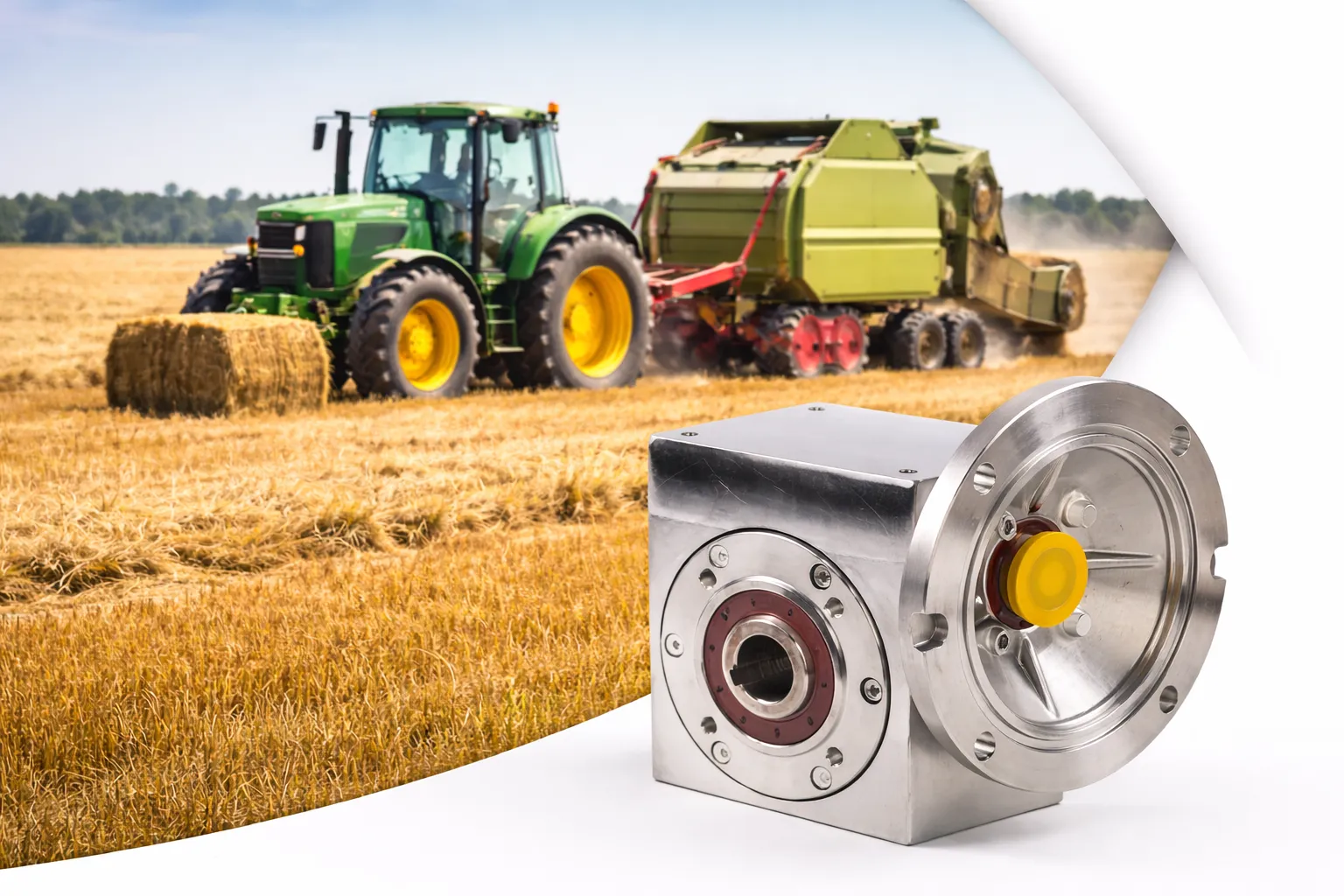
Ku-band and Ka-band VSAT terminals in the 60–120 cm aperture class, tracking antennas for UAV communications, and electro-optical telescope mounts all require fine angular positioning with minimal backlash under substantial structural loads. The P70-AR at 20:1 or 30:1 provides the combination of precision (≤0.066° backlash), load capacity (Fr2=800 N), and efficiency (85%/78%) that these applications demand. For a 90 cm antenna dish weighing 12 kg, the radial load on the elevation axis output shaft can reach 400–600 N under maximum wind loading — within P70's Fr2 limit. The grease lubrication performs reliably in outdoor environments from −20°C to +60°C without oil level inspection or drain-back concerns.
▸ Military Equipment & Precision Optical Systems
Unmanned ground vehicle steering joints, turret slew mechanisms (at reduced scale), electro-optical gimbal axes, and surveillance camera pan/tilt units in the 5–15 kg camera/sensor class are natural applications for the P70. The load capacity handles the structural weight; the AR class provides the angular precision; the grease lubrication eliminates oil management in deployed environments. The reflected inertia data in the specification table is the kind of quantified parameter that defence procurement engineers need for control system verification — and it is available for every ratio across all three backlash classes.
Ondrives & Rino P70 Replacement Compatibility
The VRV030 P70 is an aftermarket-compatible replacement for the Ondrives & Rino P70 worm gear reducer. Korea Ever-Power is not affiliated with Ondrives & Rino and the VRV030 is not an OEM part. For original parts, contact the original manufacturer.
| Parametr | Ondrives & Rino P70 | VRV030 P70 | Status |
|---|---|---|---|
| Available ratios | 10, 12, 15, 20, 30, 60, 120 | 10, 12, 15, 20, 30, 60, 120 | ✓ Full match |
| Backlash classes | Standard / A / AR | Standard / A / AR | ✓ Full match |
| Max output radial load Fr2 | 800 N | 800 N | ✓ Match |
| Max output axial load Fa2 | 600 N | 600 N | ✓ Match |
| Nom. / Max input speed | 1,000 / 3,000 rpm | 1,000 / 3,000 rpm | ✓ Match |
| Mazání | Grease | Shell Gadus S5 V4P 2.5 | ✓ Compatible grade |
| OEM / aftermarket | Original manufacturer | Aftermarket replacement | — Verify in application |
Kontakt Korea Ever-Power for dimensional drawings and test certificates. Sample testing before fleet replacement is recommended for all precision applications.
Shodné komponenty pohonu
At the P70 load level, replacing the worm wheel with an incorrect alloy grade or profile tolerance can quickly degrade the backlash class of an AR-specified unit during early service. Sourcing wear components from Korea Ever-Power ensures the replacement wheel and shaft maintain the original precision class.

⚙ Šnekové kolo — červčervové kolo.top
Bronze worm wheels for the P70 frame in Standard, A, and AR backlash class profiles. Specify ratio and class — the gear surface finish and profile accuracy requirements differ between classes. P70-AR wheels require the tightest profile tolerance available, and we manufacture and inspect to this class before supply.
⚙ Šneková hřídel — šnekové kolo.horní
20CrMnTi carburised and ground worm shafts for the P70 frame, DIN 3974 accuracy class matched to the backlash specification. The larger centre distance of the P70 requires a correspondingly larger worm diameter — specify P70 frame and ratio, not just the ratio, when ordering replacement shafts.
⚙ Hřídelové spojky
At the P70 output torque level, flexible jaw or disc couplings are standard on the output shaft to absorb minor misalignment between the gearbox output and the driven mechanism. For AR-class applications, zero-backlash disc or bellows couplings on the input shaft maintain the system backlash budget. Contact us with shaft diameters, peak torque, and backlash class for a coupling recommendation matched to the P70 specification.
Často kladené otázky
Why is the P70's reflected inertia at 10:1 so much higher than the P45's?
→ Reflected inertia scales with the fourth power of the worm gear radius — doubling the worm diameter increases the reflected inertia by 16×. The P70 has a significantly larger worm and wheel than the P45 to achieve 800 N Fr2 from the output shaft bearing. That larger geometry is what makes the P70's 6.04×10⁻⁵ kg·m² (at 10:1) approximately 10× the P45's 6.15×10⁻⁶ kg·m². When upgrading from P45 to P70, the servo drive must be retuned for this increased reflected inertia.
Is the P70 truly self-locking at 120:1?
→ At 50% efficiency the P70 at 120:1 is in the self-locking range under static conditions. However, the self-locking condition is sensitive to temperature, vibration, and lubrication state — at elevated temperatures, grease viscosity decreases and the friction coefficient drops, moving the operating point closer to the back-drive threshold. For safety-critical hold applications, always test the static lock under the actual load, temperature, and vibration conditions of the installation. Do not rely solely on the efficiency figure for safety-critical mechanical holding without experimental verification.
What is the maximum static axial load the P70 output shaft can sustain?
→ The rated maximum output axial load is Fa2=600 N in the published specification. This is the continuous rated value. Short-duration peak loads above this can be tolerated by the output shaft bearing, but continuous loading above Fa2=600 N will reduce bearing life. If your application has an axial load component that exceeds 600 N, contact Korea Ever-Power with the load profile — it may be possible to accommodate higher axial loads through bearing selection or preload adjustment, or a different frame size may be more appropriate.
Can the P70 be used in a horizontal shaft orientation?
→ Yes. The grease lubrication (Shell Gadus S5) makes the P70 fully orientation-independent — horizontal, vertical, inverted, or angled shaft configurations all work without oil displacement concerns. This is one of the primary design advantages over oil-bath gearboxes when used in robotic or gimbal applications where the housing orientation changes during operation.
How often should the Shell Gadus S5 grease be replenished in the P70?
→ Shell Gadus S5 V4P 2.5 is a long-life synthetic grease designed for continuous duty in precision gearboxes. Under normal operating conditions (ambient temperature within the rated range, load within the rated Fr2 and Fa2), the grease life in the P70 is typically 8,000–12,000 hours. At elevated temperatures (above 50°C continuous) or under sustained high load near the Fr2 limit, grease life shortens. For critical applications, we recommend a grease replacement at the first 1,000-hour interval and then every 5,000 hours thereafter — or after any period of unusual overload or overtemperature.
Co říkají zákazníci
Kim Tae-young, Robot Design Engineer, Incheon Industrial Robot OEM (2024)
"Used P70-20A for the shoulder joint on a 10 kg payload industrial robot. The 85% efficiency at 20:1 allows back-drivability for our collaborative mode. Measured backlash at delivery: 0.10°, within A-class spec. Servo tuning took longer than expected due to the high reflected inertia — the published 3.57×10⁻⁵ figure at 20:1 matched our measured system inertia closely. Cost about 45% less than the OEM unit."
Choi Sung-hyun, RF Systems Engineer, Seoul Defence Electronics Co. (Q3 2024)
"Antenna azimuth drive on a tactical communications vehicle — P70-30AR. The 78% efficiency at 30:1 gives us enough self-locking to hold pointing in field conditions without a supplementary brake. AR class backlash tested at 0.055° on the first sample unit. Compact enough to fit the available envelope. Delivered with dimensional certificate as requested."
Park Jae-hyun, Mechanical Design Lead, Daejeon Telescope Equipment Maker (2025)
"P70-15AR for an amateur observatory mount elevation axis. 86% efficiency and 800 N Fr2 capacity handles a 12 kg OTA at slew rates up to 5°/second without any resonance issues. The reflected inertia data enabled accurate servo design from simulation — no surprises during commissioning. Running six months without backlash degradation."
Lee Dong-hoon, Automation Engineer, Gyeonggi-do Precision Machine Tool Maker (late 2024)
"P70-20AR for a tool turret rotation axis where we replaced a heavier planetary stage + brake combination. The worm's self-locking at higher ratios was not what we needed (we use 20:1 for back-drivability), but the AR class backlash gave us the positioning we needed on a much smaller mechanical package. Weight saving of 2.1 kg vs the previous solution."
Yoon Beom-seok, Systems Integration Engineer, Busan UAV Technology Co. (Q4 2024)
"Gimbal elevation axis on a payload stabilisation mount — P70-12A. The grease lubrication was the key requirement: the gimbal tilts through ±90° so an oil-bath unit was not an option. A class backlash was adequate for the stabilisation loop bandwidth. Three units deployed for over 8 months without any lubrication-related issues."
Související produkty
-
Šnekový převodový stupeň EP-NRV s vstupem do hřídele | Vstup s plným hřídelem
-

Šnekový reduktor WPWDKO | Dvojitá klínovaná hřídel + vertikální výstup
-

Vertikální šnekový převod WPWKO | Výstup hřídelí dolů
-

Dvoustupňový šnekový reduktor WPEX | Dvoustupňový pohon
-
Šnekový převod s dvojitým vstupem EP-NMRV-VS | Rozšíření synchronizačního pohonu a enkodéru
-
Šnekový převod XRV050 | Krytí IP67 pro porážku a oplachování
-

Šnekový převod EP-NMRV s výstupní přírubou
-

Šnekový převodový reduktor / synchronní šnekový převodový motor řady RV pro šroubový zvedák